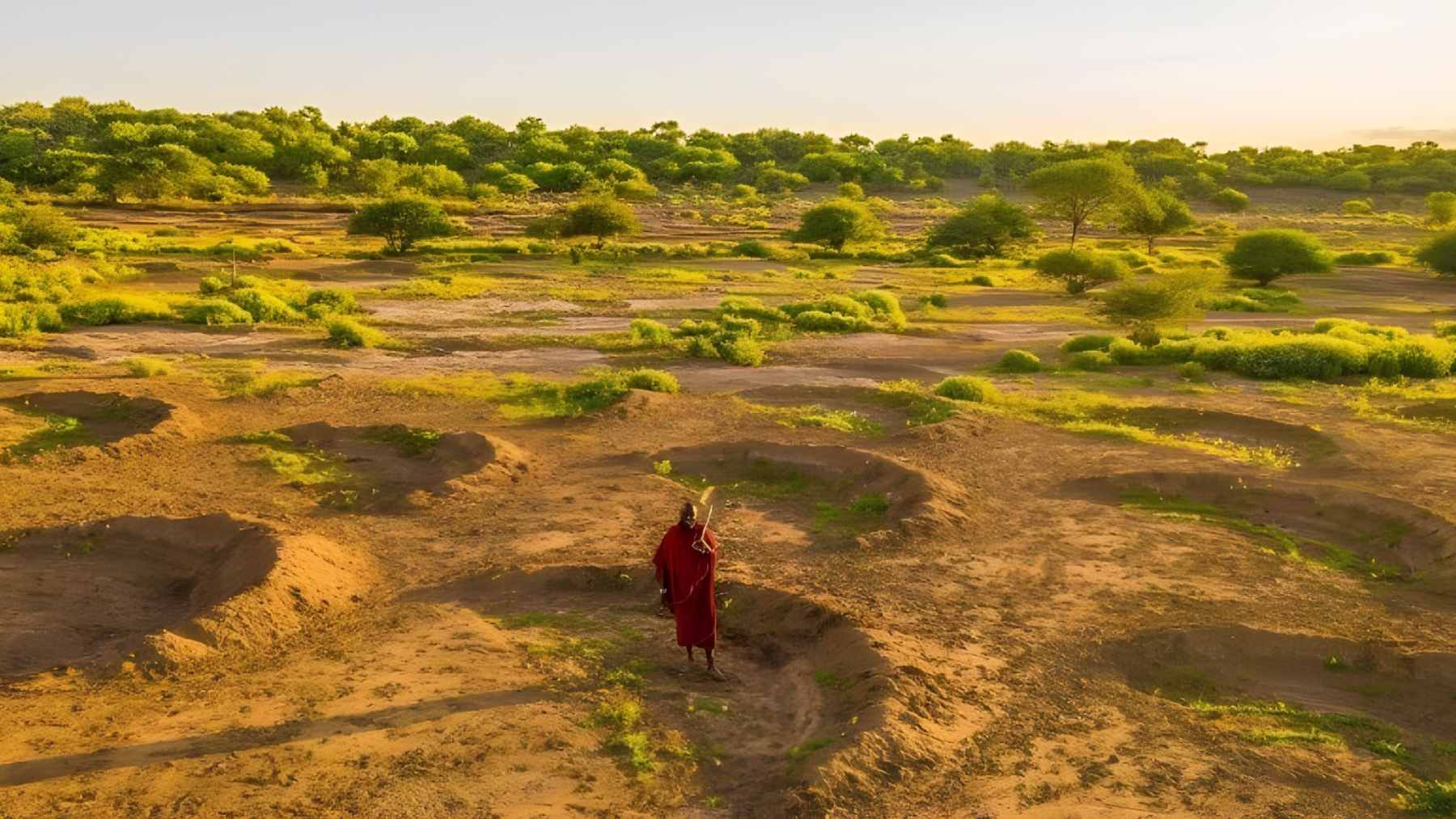
In the dry heart of central Tanzania, farmers are quietly pulling off something that sounds impossible. A forest is returning without anyone planting a single tree.
Using a low-cost restoration method known as Farmer-Managed Natural Regeneration (FMNR) and locally called Kisiki Hai, communities in the Dodoma region are coaxing new trees from old stumps and roots that never really died.
Project data from the regreening organization Justdiggit and Tanzanian partner LEAD Foundation report more than 15.2 million trees regenerated, about 311,000 hectares under restoration and roughly 5.5 billion liters of water retained in 2024 in Dodoma alone.
The underground forest and FAO forest data
What makes this possible? Under many seemingly barren fields lies what experts describe as an underground forest. According to the FAO Global Forest Resources Assessment 2020, 93% of the world’s forests are classed as naturally regenerating. Globally this type of forest still dominates, even though the overall forest area is shrinking.
In Tanzania, analysis based on the same FAO data shows about 45.1 million of the country’s 45.8 million hectares of forest are naturally regenerating, while only around 0.5 million hectares are planted.
How FMNR works on farms
That means the problem is often not total loss of trees, but repeated cutting and burning that keep regrowth stuck at shrub height. FMNR leans into that reality.
Farmers identify a living stump, select a few of the strongest shoots, prune away the rest, then mark and protect those stems so they can grow into full trees while crops continue in the same field.
Tony Rinaudo and the spread of FMNR
The idea took shape in the 1980s in Niger, where agronomist Tony Rinaudo saw around 80% of planted seedlings die in harsh Sahel conditions.
One day he realized that what looked like scrubby bushes were actually trees resprouting from old stumps, a moment he later described as discovering that the solution was “literally at our feet.”
From there, FMNR spread across Africa. World Vision reports that its programs alone have restored more than one million hectares using the technique and notes that FMNR is now being implemented in at least twenty seven countries, from Niger and Ghana to Tanzania and Timor Leste.
Climate resilience, shade, and soil moisture
In Dodoma, the method is embedded in daily routines rather than one off projects. Champion farmers teach neighbors how to prune, and radio shows plus simple text messages remind people when to thin branches or protect new growth.
Shade returns within a few years, soil holds more moisture, and families spend less time walking long distances for fuelwood or watching crops wilt under bare, exposed sun.
For communities living with erratic rains and rising heat, this is not a glossy tree planting campaign. It is a low-tech habit that works with the hidden biology of their land and puts control in farmers’ hands.
The official statement was published by Justdiggit Dodoma, Tanzania.