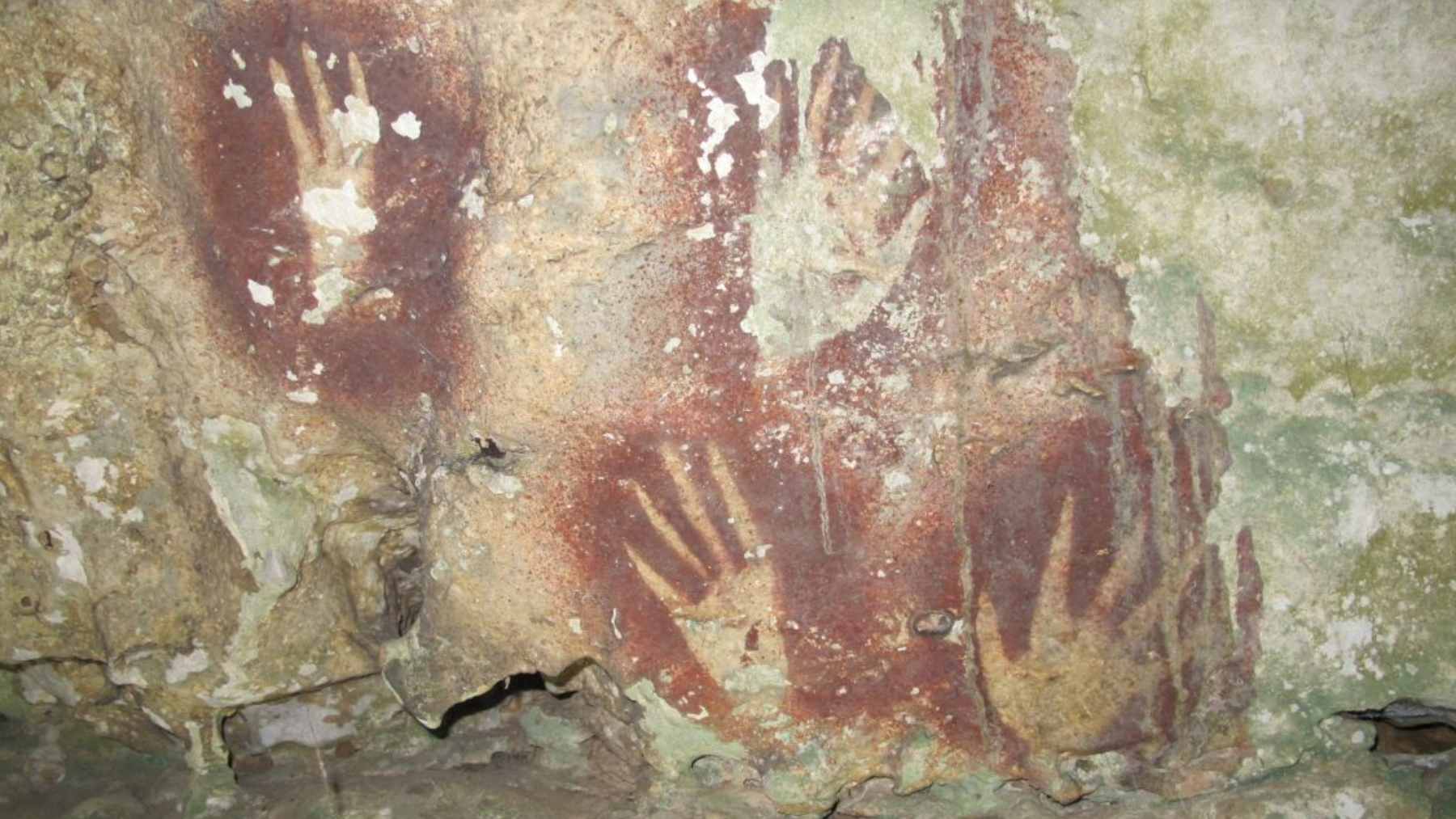
Long before people painted bison on French cave walls, someone stood at the back of a limestone chamber on the Indonesian island of Sulawesi, pressed a hand to the rock, and sprayed red pigment around their fingers.
That simple outline is now considered the oldest known rock art made by our species, and it is quietly rewriting the story of where human imagination first bloomed.
In a new study in the journal Nature, an international team dated a faded hand stencil in the cave of Liang Metanduno on Muna Island to at least 67,800 years ago. The art sits on the southeastern flank of Sulawesi, inside the oceanic island zone known as Wallacea, which lies between mainland Southeast Asia and the ancient continent of Sahul.
That minimum age makes the stencil the earliest securely-dated cave art anywhere on Earth and edges out a red hand mark in Spain’s Maltravieso cave by about one thousand one hundred years.
The image itself is easy to picture. A reddish outline of a left hand, fingers slightly elongated and narrowed so they look almost like claws, reaches out from the rock.
That stylized, clawed look appears in other Sulawesi caves too, turning a simple stencil into a recognizable regional “signature” and hinting at a shared visual language that stretched across generations.
Reading time in a crust of stone
To work out when that hand was made, the team did not try to date the pigment itself. Instead, they sampled the thin crusts of calcite that formed on top of the art when mineral rich water trickled down the cave wall.
Those crusts carry tiny traces of uranium that slowly decay into thorium at a steady pace. With a technique known as the uranium thorium method, scientists can measure the ratio between the two elements and calculate when the mineral layer grew.
One of those calcite samples yielded an age of at least 67,800 years. Since the hand stencil lies beneath that layer, the artwork must be older than the calcite that covers it.
Other nearby motifs, including additional hand stencils and a small, humanlike figure, returned younger dates, suggesting people kept returning to this wall for tens of thousands of years.
The approach builds on methods first refined on European cave art, where similar carbonate crusts helped prove that some red symbols were created by Neanderthals.
Now that same strategy is being applied across Indonesia, creating a timeline of images that reaches much further back than earlier estimates and relies on lab techniques as carefully tuned as those used in plastics or materials research that seem almost like a simple trick when you hear them described.
Europe loses its monopoly on “first artists”
For most of the 20th century, schoolbooks pointed to the Lascaux cave paintings in France and the lions and rhinos of Chauvet cave as the first great flowering of human art. Those Ice Age masterpieces are still astonishing, but they no longer sit alone at the starting line.
Over the past decade, researchers have uncovered much older scenes in Sulawesi, including narrative hunting images dated to more than 51,000 years that were published as narrative cave art in Indonesia.
The new hand stencil pushes the record even further back and anchors that artistic tradition deep in time. To a large extent, it undercuts the idea that Europe was the cradle of symbolic culture and fits with a broader pattern where advanced behavior appears wherever early humans had time to settle and experiment.
A window onto the first sea crossings to Australia
Geography matters here. Sulawesi lies in Wallacea, the belt of islands between ancient Sunda to the west and Sahul to the east, where Australia and New Guinea once formed a single landmass. To reach Sahul, early humans had to make deliberate sea crossings through this island chain.
If people were already decorating cave walls in Sulawesi nearly sixty eight thousand years ago, that suggests communities here had enough stability and shared culture to invest time in art. That fits with models of early human migration to Australia that place the ancestors of Indigenous Australians in Sahul by around sixty five thousand years ago.
Rock art becomes more than decoration in that context. It is a quiet footprint of planning, storytelling, and identity carried by groups who were also navigating open water and new coasts.
Other discoveries keep pointing in the same direction. From jungle expeditions that reveal new species hidden among boulders to genetic work that shows familiar creatures are really several species, science is steadily filling in a much more complex map of the ancient world than many of us grew up with.
Fragile art in a changing world
There is a catch. The very calcite crusts that lock in these ages are vulnerable. Changes in temperature and humidity can accelerate how fast the minerals dissolve or regrow. In some parts of Indonesia, researchers already see rock art flaking away as new crusts blister and peel, likely influenced by shifting climate and local land use.
On top of that, mining and quarrying can threaten the limestone hills that shelter the caves. A hand stencil that survived almost seventy thousand wet seasons could vanish in a single human lifetime if the rock face is blasted for stone or the cave ceiling collapses.
That is why archaeologists often argue that documenting these panels is as urgent as deciphering them.
At the end of the day, this new handprint from Sulawesi is a reminder that our species did not wake up one morning in Europe and suddenly become “artistic.” Creativity grew in many places where people had the time, tools, and stories to share, from lunar dust that forced scientists to revisit old theories to pigments sprayed in the dark of a cave.
Each new find adds another piece to that broader picture, and each one makes the quiet work of protecting these sites feel a little more like a race against the clock.
The study was published in Nature.