Laser-powered drones are edging closer to something that once sounded like science fiction, staying aloft for days at a time without ever landing to recharge.
A new ground-to-air laser system from PowerLight Technologies, developed with backing from the United States Department of Defense, has just passed subsystem tests that show it can beam kilowatt-class power to a drone in flight and keep its batteries topped up.
How laser charging works for drones in flight
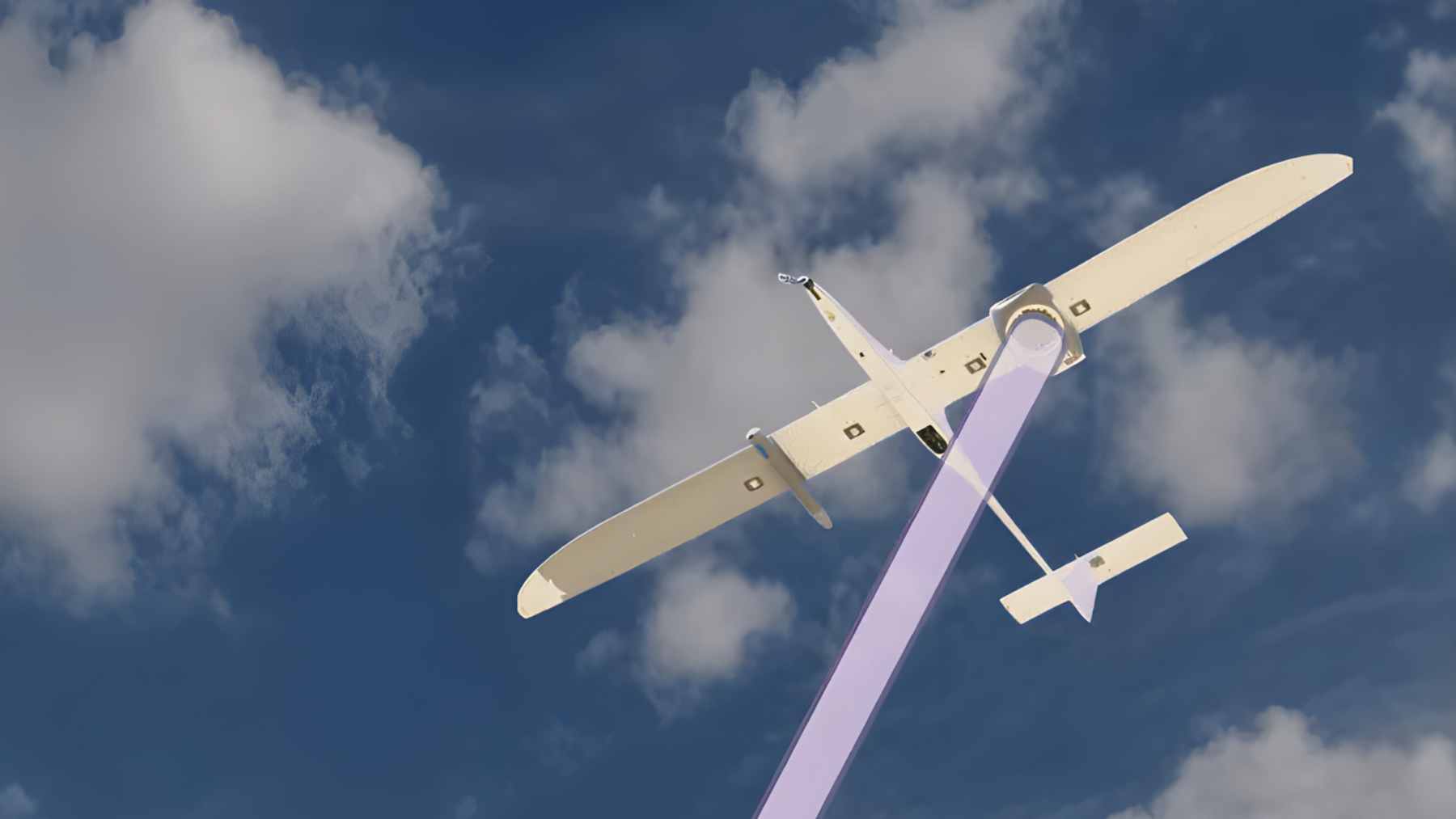
Instead of swapping batteries on a runway, the idea is to shoot an invisible laser from the ground to a special receiver mounted on the aircraft. That receiver weighs about six pounds, captures the narrow-band laser light and converts it into electricity that feeds the drone’s battery pack.
At the same time, embedded electronics send constant telemetry back to the ground so the transmitter can adjust power delivery and keep the beam locked on target at altitudes up to roughly five thousand feet and over distances on the order of two kilometers.
PowerLight’s engineers describe the result as a kind of wireless power line in the sky rather than a single, fixed charging spot. The autonomous transmitter uses optical tracking to follow a cooperative aircraft, dials output up or down as needed, and layers in multiple safety interlocks for mixed civilian and military airspace.
For anyone who has watched a quadcopter land just because a battery icon turned red, the appeal is obvious.
K1000ULE long endurance drone and military applications
The first airframe set to prove the concept in full flight is the K1000ULE, an ultra-long-endurance electric drone built by Kraus Hamdani Aerospace. That aircraft already holds a group 2 endurance record after flying more than seventy five hours in a single mission at the Pendleton UAS Range, and it has joined the Pentagon’s Blue UAS cleared list for trusted platforms.
Pairing that kind of glider-like efficiency with in-flight laser charging is what gives military planners hope for near-continuous surveillance and communications nodes that linger quietly above remote areas.
DARPA power beaming experiments and technical limits
This laser system also fits into a wider push by the Defense Advanced Research Projects Agency and others to move serious power without wires.
In separate tests, the agency has already shown that more than 800 watts can be sent by laser across 8.6 kilometers to a stationary receiver, hinting at what might be possible when those capabilities converge with mobile platforms.
Still, infinite flight on paper is not the same as a drone cruising through real weather and crowded airspace. PowerLight’s own roadmap acknowledges that early 2026 will be the key moment, when fully-integrated tests aim to charge a K1000ULE in flight rather than just in subsystem demos.
Factors such as clouds, smoke, heat shimmer and airspace rules will all shape how often and where such beams can operate.
Civilian uses of laser-powered drones and emergency response
If the system works as advertised, it could eventually spill over into civilian life, from disaster relief drones that watch a flooded region all night to environmental monitors that circle over wildfires without needing fuel trucks or charging pads.
For now, though, most people will notice the change in indirect ways, such as more persistent military eyes in the sky or fewer gaps in emergency communications after storms.
The press release was published by PowerLight Technologies.