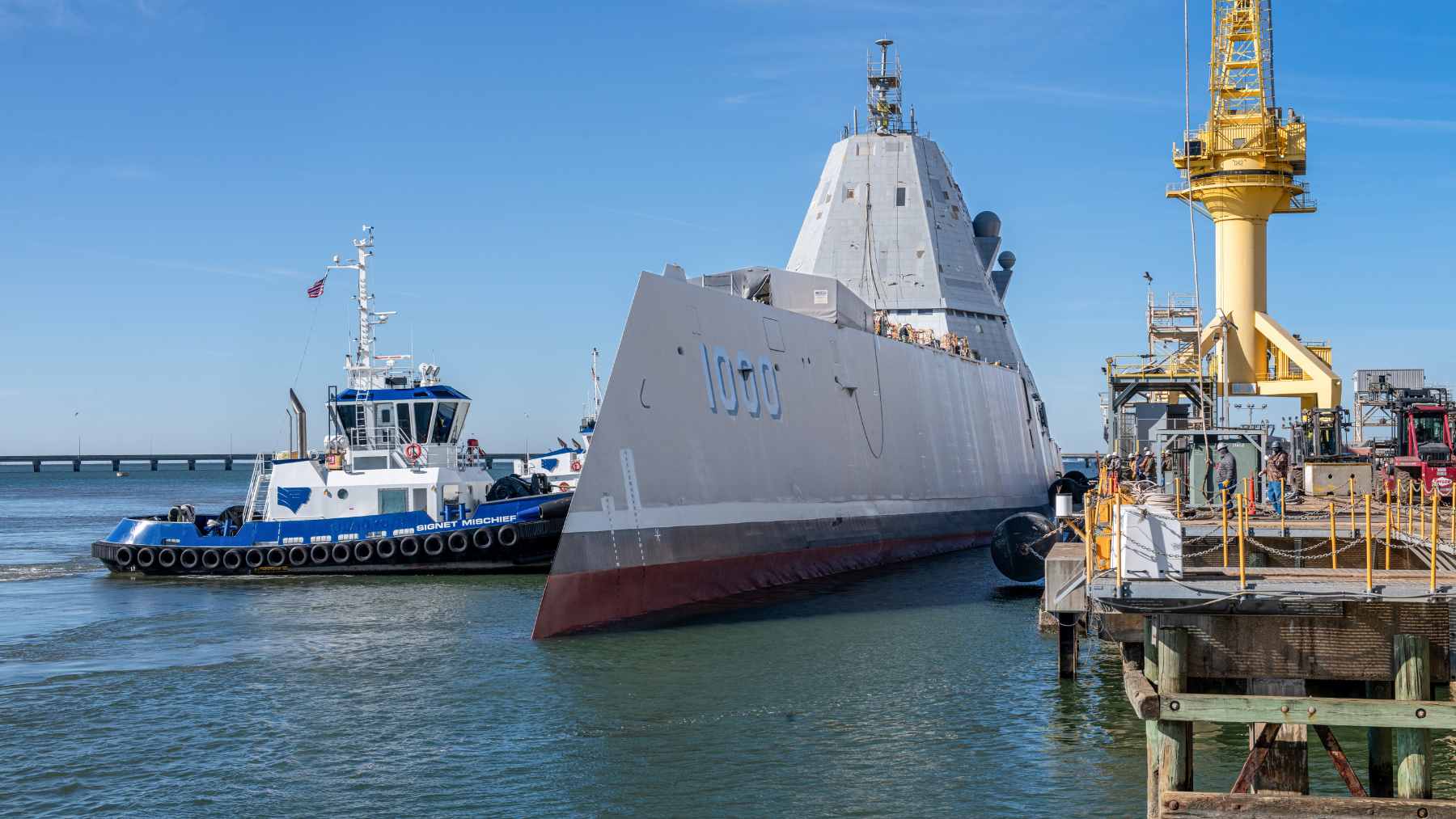
USS Zumwalt, the US Navy’s most futuristic destroyer, has just finished builder’s sea trials after a long modernization in Pascagoula, Mississippi. Shipbuilder HII confirms that the stealth vessel is now the first surface ship prepared to field the Conventional Prompt Strike hypersonic weapon system, following extensive upgrades at Ingalls Shipbuilding. For the Navy this is a milestone in firepower. For everyone else it is a fresh reminder that modern warfare still runs on carbon.
So what does a ship like this have to do with climate change and the health of the oceans?
From big guns to hypersonic tubes
Zumwalt arrived at Ingalls Shipbuilding in August 2023. Yard workers shifted the ship onto land to carry out deep structural work, removing two 155 millimeter Advanced Gun Systems and installing large missile tubes designed for hypersonic weapons, before undocking the destroyer again in late 2024 for final preparations and trials at sea in early 2026.On paper, Zumwalt is now the first of three ships that will offer fast, long-range conventional strikes from the ocean’s surface. That new mission sits inside a much bigger climate story.
The Pentagon’s carbon shadow
Researchers with Brown University’s Costs of War project describe the US Department of Defense as “the world’s largest institutional consumer of fossil fuels” and the single biggest institutional source of greenhouse gases. Their work estimates that US military operations and infrastructure have produced several billion tons of carbon dioxide equivalent since the mid-1970s, placing the Pentagon’s long-term emissions above those of many medium-sized countries.
Why ships matter so much
According to a Navy energy vision document, around three quarters of the service’s energy use happens “afloat” in ships, aircraft and other mobile systems, with most of that coming from liquid fuels. In simple terms, a large part of the US military’s carbon footprint is burned at sea, far from the monthly electric bill yet firmly inside the same atmosphere.
Zumwalt is often cited as a step toward a more flexible fleet. The destroyer uses integrated electric propulsion, where powerful gas turbine generators supply electricity to motors and electronics instead of turning propeller shafts directly.
This design gives the ship far more electrical power than older destroyers and can improve efficiency by letting crews run engines at steadier, more optimal settings.
Even so, the fuel in those turbines remains a fossil fuel derived marine distillate. Studies of marine diesel exhaust show a familiar mix of carbon dioxide, nitrogen oxides, sulfur oxides and soot that harms air quality and adds to warming along busy coasts and port cities.
Noise in the ocean’s soundscape
Climate emissions are only one part of the environmental footprint. Any large, fast ship adds to underwater noise, and naval vessels also use active sonar during some training and operations. Reviews of marine mammal research find that chronic shipping noise can change how whales and dolphins communicate, feed and rest, sometimes pushing them out of key habitats or forcing them to vocalize more loudly just to be heard.
Steel, shipyards and hidden emissions
Behind every sleek destroyer sits a huge industrial chain. Steel accounts for more than three quarters of a typical ship’s weight, and the steel industry is responsible for an estimated 7% to 9% of global greenhouse gas emissions.
Life cycle studies of shipbuilding show that mining, smelting and fabrication all add significant climate costs before a ship ever leaves the yard, with most remaining emissions then coming from decades of fuel use at sea.
Shared security, shared responsibility
For defense planners, Zumwalt’s new hypersonic role is meant to deter rivals and respond quickly to crises at sea. For climate scientists and coastal communities, it is another reminder that decisions about security, industry and technology all land in the same carbon budget as cars, factories and power plants.
Most people will never set foot on a destroyer. They can still press governments to count military emissions, invest in cleaner fuels and technologies, and apply climate targets to fleets as well as family vehicles. At the end of the day, national security and environmental security depend on the same stable climate and the same living ocean.
The official statement was published by HII.