Foldable phones look futuristic until the crease starts to look a little tired. Curved TVs, rollable monitors, fitness trackers that hug your wrist all face the same problem when you bend them enough times. Their flexible OLED panels slowly lose brightness where the material is under the most stress.
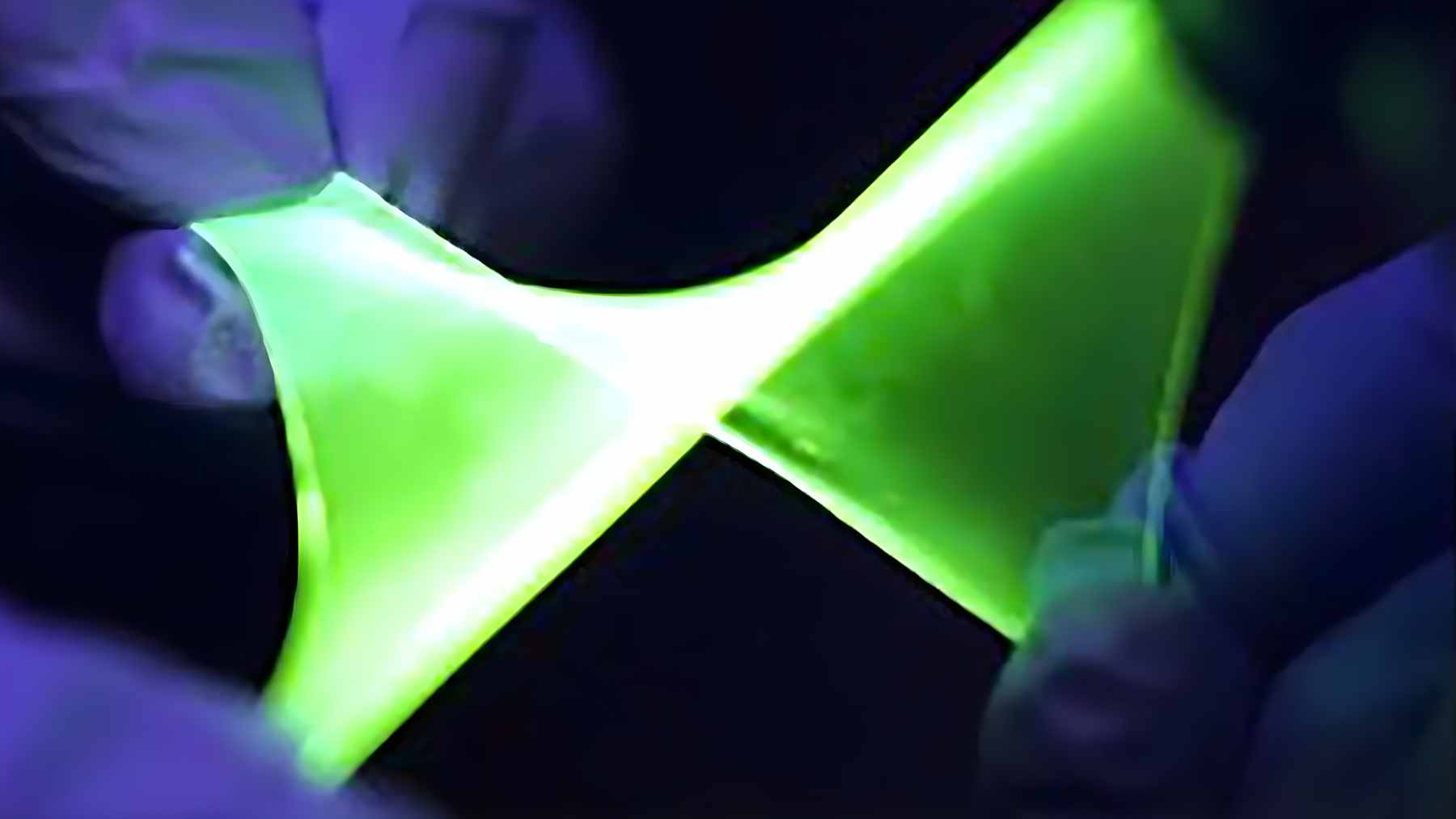
A team from Seoul National University and Drexel University now reports a stretchable OLED design that keeps shining even when pulled to about 60 percent longer than its original length. The devices reach a record external quantum efficiency of about 17 percent for a fully stretchable display and hold on to most of their light output under repeated deformation.
Why OLED durability breaks down in foldable devices
At the heart of the problem is how OLEDs are built. Current flexible screens rely on very thin conductors that have to be transparent and also survive bending.
In practice, they crack or form tiny breaks when a phone is opened and closed or a wearable is stretched around an elbow. Adding soft polymers for flexibility often makes charge transport worse and the image dims over time.
Companies such as Samsung helped popularize flexible OLEDs in the 2010s, but the brightness penalty has been a persistent tradeoff.
The new work attacks that tradeoff from two sides. First, the team designed an intrinsically stretchable light emitting layer called an exciplex assisted phosphorescent, or ExciPh, film. This material can stretch to more than double its length and still guide electrical charges into so-called excitons, the short-lived states that produce light.
In lab tests, more than 57 percent of those excitons turned into visible photons, compared with roughly 12 to 22 percent for many polymer-based OLED emitters.
MXene electrodes and silver nanowires enable stretchable conductors
To make that layer behave like a rubbery screen instead of a brittle chip, the researchers embedded it in a thermoplastic polyurethane elastomer.
Then they paired it with new electrodes built from MXene, a highly conductive two-dimensional nanomaterial first developed at Drexel University and silver nanowires. Together, these form a stretchy network that lets flakes slide past one another when the device is pulled, avoiding the microfractures that normally kill a display.
In a news release, materials scientist Yury Gogotsi called it a long-standing challenge. “This study addresses a longstanding challenge in flexible OLED technology, namely, the durability of its luminescence after repeated mechanical flexion.”
The new MXene-based electrodes help keep charge injection efficient even as the panel bends and stretches.
To show that the concept is more than a single pixel in a test rig, the group built small green displays, including a glowing heart shape and numeric digits, and a full-color stretchable panel.
When the devices were stretched to 60 percent strain, performance dropped only about 10.6 percent, and after 100 gentle stretching cycles they still delivered roughly 83 percent of their initial brightness.
Wearable electronics and health patches could benefit next
Why does this matter beyond the lab bench? Imagine a health patch on your chest that shows your heart rate or blood flow in real time without needing a rigid smartwatch, or a soft cast that can display pressure on a healing bone every time you get up from the couch.
The same kind of stretchable OLEDs could one day wrap around steering wheels, bike helmets, or industrial tools, lighting up warnings exactly where a hand naturally rests.
There is still a long road between an eye-catching demo and the screen on your next phone. The researchers note that future work will need to test other flexible substrates, tune colors and brightness for mass market devices, and simplify fabrication so these complex stacks can be produced at scale.
Long-term stability, especially in sweaty, real-world environments on skin, also has to be proven.
For now, though, a tiny bright green heart that keeps glowing while it stretches is a clear sign that the old rule about bendable screens getting dimmer is starting to crack.
The study was published in Nature.