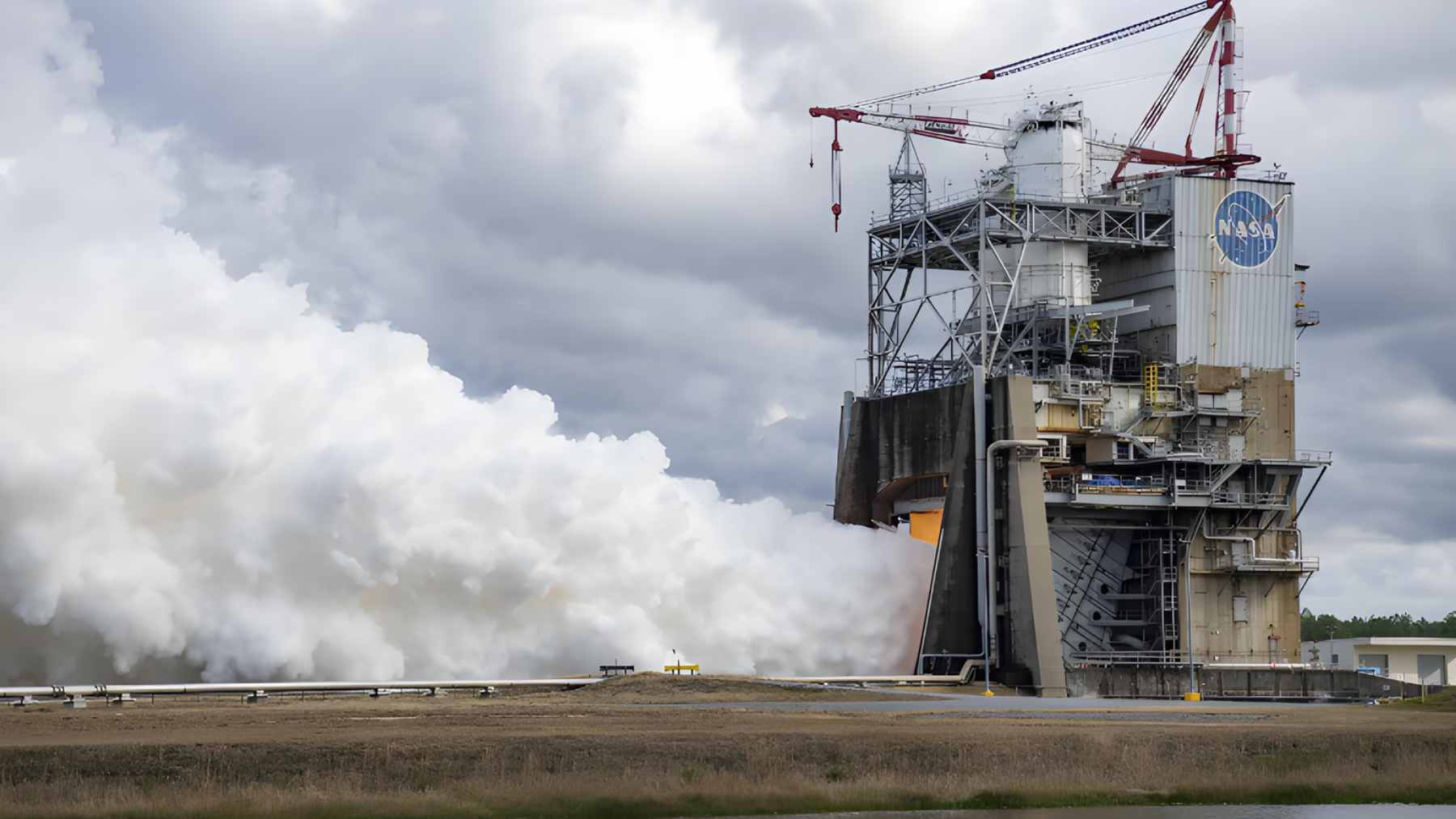
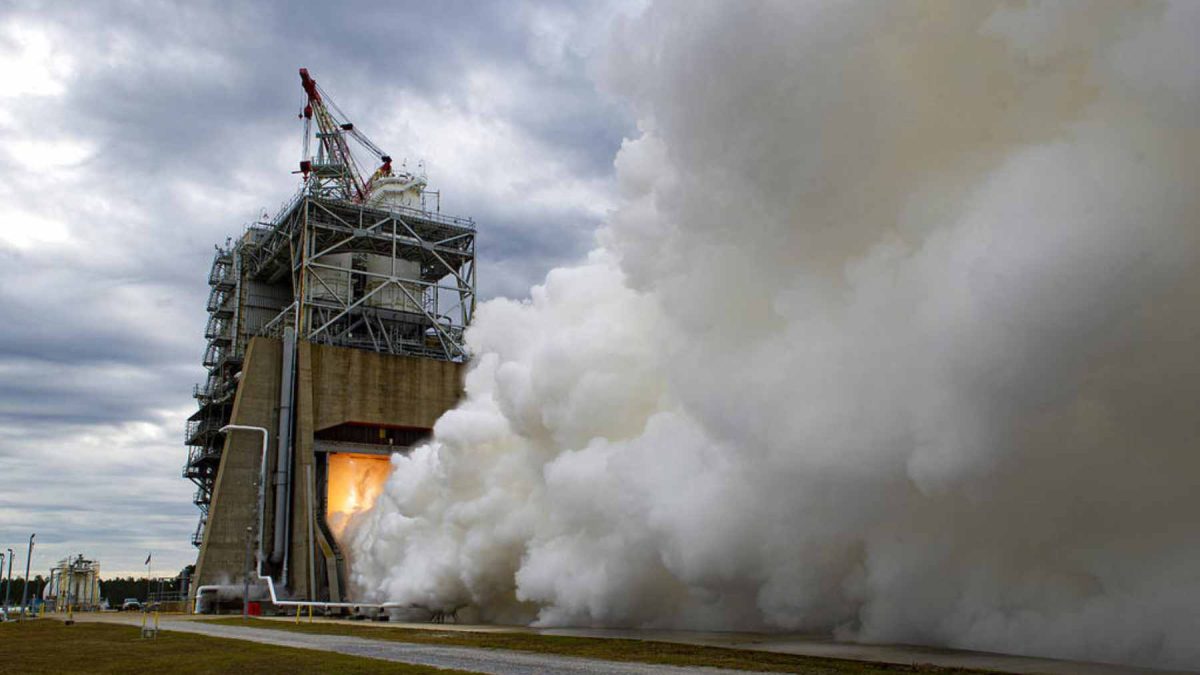
On a chilly January afternoon in Mississippi, a single rocket engine lit up the sky and shook the wetlands around NASA’s Stennis Space Center. The agency fired RS-25 engine No. 2063 for five full minutes on the Fred Haise Test Stand, pushing it to as much as 109% of its rated power and proving it ready to fly on the Artemis IV Moon mission.
At first glance, this sounds like pure rocket fan news. Yet it also sits squarely inside a growing debate about how much pollution our rush back to the Moon will leave in Earth’s atmosphere.
A powerful engine with a cleaner core
The RS-25 has a long history. It once powered the Space Shuttle and now serves as the workhorse engine on the core stage of NASA’s Space Launch System, or SLS. Four of these engines will help lift the Orion spacecraft and its crew away from Earth with more than two million pounds of thrust from the core stage alone.
Unlike many commercial rockets that burn kerosene, the RS-25 uses liquid hydrogen and liquid oxygen. When those propellants react, the main exhaust is water vapor rather than carbon dioxide, and NASA notes that engines of this type produce exhaust that is almost entirely water. For the most part, that makes the RS-25 one of the cleaner options in today’s rocket toolbox.
So where is the environmental catch?
Solid boosters and an unseen chemical trail
The SLS does not rely on the RS-25 engines alone. It also uses a pair of five-segment solid rocket boosters that burn a mix of aluminum powder and ammonium perchlorate.
Studies of solid rocket fuels show that this type of propellant releases aluminum oxide particles and chlorine bearing gases when it burns, chemicals that scientists link to ozone depletion and changes in upper-atmospheric chemistry.
Researchers who track rocket pollution point out that launches inject water vapor, nitrogen oxides, black carbon and alumina directly into high layers of the atmosphere, where even relatively small amounts can have an outsized impact on ozone and on how heat is trapped.
The total share of global emissions from rockets is still tiny compared with cars, planes or power plants, but launch numbers are climbing fast. That is what keeps climate scientists awake.
How the test fits into NASA’s Moon to Mars plans
Engine No. 2063 carries its own backstory. It was originally installed on the Artemis II core stage, then removed in 2025 after engineers found a hydraulic leak on the main oxidizer valve actuator, the hardware that helps control the flow of propellant into the combustion chamber. After the actuator was replaced, NASA required a full hot fire before the engine could ever fly with astronauts, a procedure the agency calls a confidence test.
With that hurdle cleared, the engine is set to join three other RS-25s on the SLS core stage for Artemis IV, part of a broader campaign that, in NASA’s own words, uses Artemis to explore the Moon for scientific discovery, technology advancement and to learn how to live and work on another world.
Artemis II, targeted as early as February, will send four astronauts around the Moon and back to shake out Orion systems before landings resume.
Space exploration as a testbed for sustainability
Long stays on the Moon will only be possible if crews can recycle air, water and waste with extreme efficiency. That is why NASA has spent years refining Environmental Control and Life Support Systems on the International Space Station, recently demonstrating that it can recover about 98% of water used on board. Many of the same water recovery and filtration concepts are being adapted for future Artemis missions and have already inspired highly efficient purification systems back on Earth.
In practical terms, the challenge of keeping a small crew alive with almost no resupply is not so different from providing safe water in a remote village or during a long drought. Space hardware does not solve those problems on its own, but it can nudge technology in that direction.
Balancing wonder and responsibility
Researchers who model rocket emissions generally find that current launch rates create only a small climate signal, yet they also warn that a rapid increase in flights could slow ozone recovery and add new warming in the upper atmosphere. Heavy-lift missions like Artemis will likely fly infrequently, while commercial constellations and tourism account for most of the projected growth. Even so, the fuel choices made for flagship programs can influence the rest of the sector.
At the end of the day, each hot fire at Stennis is more than a rehearsal for a Moon launch. It is also a reminder that exploration and environmental stewardship now share the same launch pad. How clean future rockets become will depend on policy, on public pressure and on the engineering decisions made in test stands like the Fred Haise facility.
The press release was published by the NASA Stennis Space Center.