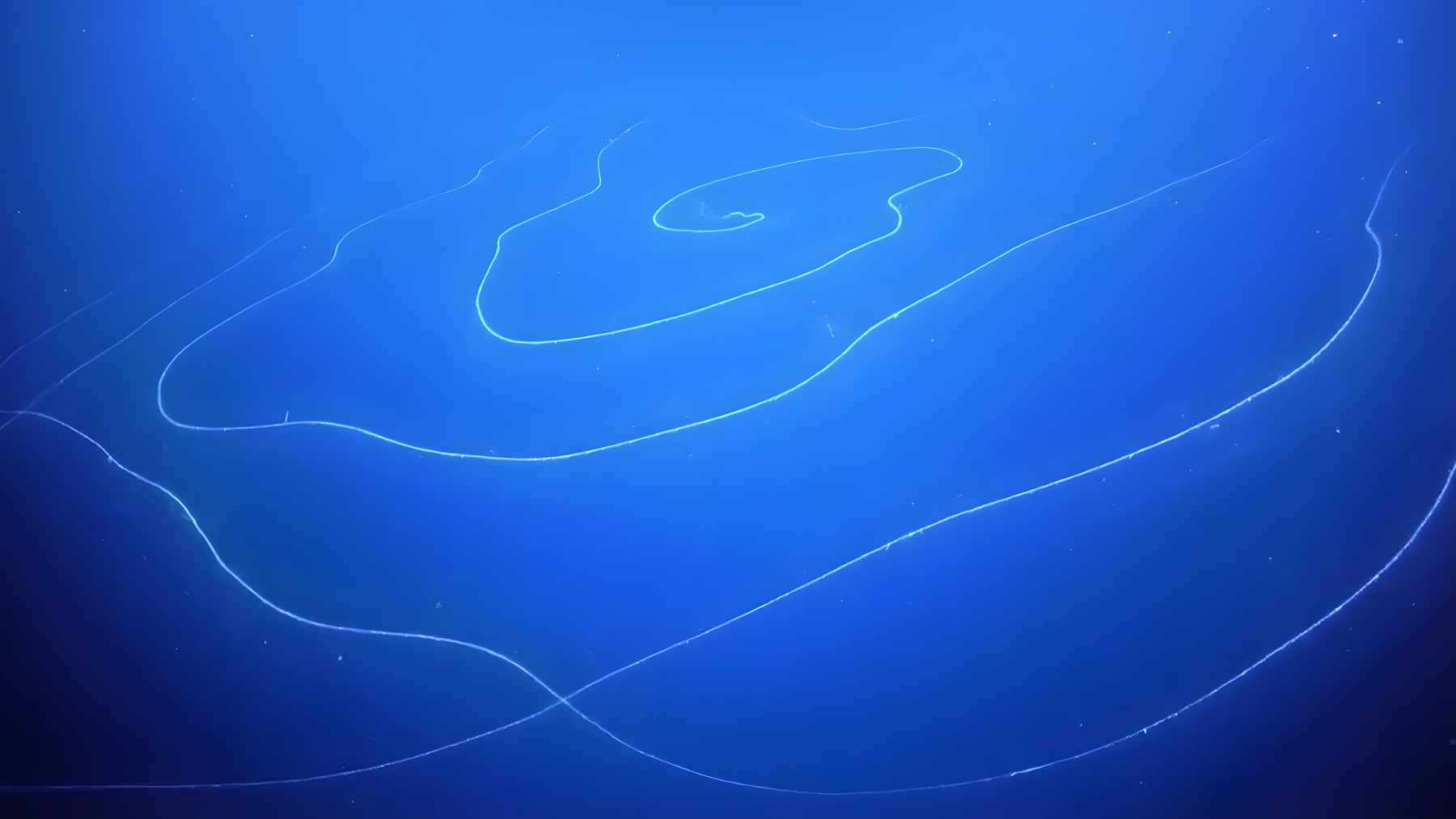
Deep in Australian waters where sunlight never arrives, a remotely operated robot slipped down to about six thousand meters and caught something on camera that should not have been there. A pale ribbon of life hung in the water column, roughly fifteen meters long, slowly coiling through canyons off the coast.
For a place where most animals are just a few centimeters across, it looked almost unreal.
Later analysis showed the creature was a siphonophore, one of the strangest life forms on the planet. At first glance it resembles a single, giant animal. In reality it is a living colony made of hundreds or thousands of tiny units called zooids, each specialized for a task such as swimming, stinging prey, or reproduction.
The find immediately invited comparison to the giant siphonophore Apolemia spotted in Western Australia in 2020, which stretched more than forty meters and was hailed as one of the longest animals ever recorded.
Deep ocean biodiversity and known siphonophore species
Biologists have been tracking siphonophores for years and now recognize more than one hundred seventy species worldwide. A global review in the journal PLOS One found that many live far below the reach of sunlight, forming delicate chains that can break or vanish before scientists ever document them.
In practical terms, that means our picture of who lives in the abyss is still badly incomplete.
Part of the explanation for these extreme sizes lies in physics. In the deep ocean, buoyancy offsets most of the pull of gravity, and bodies that are mostly water can grow very long without needing heavy skeletons. That is useful in a place where food is scarce.
A stretched out colony can sweep a huge volume of water with its tentacles, a bit like dragging a fine net through a nearly empty pantry.
How little of the deep seafloor humans have explored
What truly worries ocean researchers is how rare these encounters still are. A recent analysis led by Ocean Discovery League and published in Science Advances pulled together data from about 44,000 deep sea dives. By the team’s estimate, explorers have seen less than 0.001 percent of the deep seafloor, even though deep water covers roughly two thirds of the planet.
It is as if almost all of Earth were still a blank map.
Projects such as the Seabed 2030 initiative are racing to change that by stitching together bathymetric data from ships, research vessels, and even private companies. Their latest update suggests that a bit more than a quarter of the global seafloor has now been mapped to modern standards, yet those maps still do not show what lives there.
The result is a strange contrast. On social media we marvel at mysterious deep sea creatures washing ashore or panic when a dreaded sea slug invades popular beaches, while most of their home habitat remains unseen.
Deep sea mining risks and ocean conservation concerns
At the same time, industry is eyeing that darkness as a new resource frontier. Metals needed for batteries and clean energy technologies are buried in nodules and crusts on the deep seabed.
Governments and companies are already testing equipment, even as scientists warn that large-scale deep sea mining could stir up sediment plumes, drown filter feeders in dust, and erase species we have not yet named.
In a warming world where mosquitoes are appearing in places like Iceland and ecosystems are shifting faster than regulations, moving heavy machinery into one of the least understood environments on Earth looks like a serious gamble.
The puzzle is bigger than the ocean. In recent years, researchers have shown that lunar rocks carry more carbon than expected, forcing a rethink of how the Moon formed, a story covered in detail in a new discovery about lunar dust.
Yet by some measures, the deep sea beneath our own feet is even less explored than the lunar surface. That fifteen meter siphonophore drifting in the dark is a reminder that we are still beginners on our own planet.
What the discovery means for climate science and future research
At the end of the day, these glimpses of giant colonies and alien-like communities tell scientists two things. First, the abyss is not a barren desert but a living, structured ecosystem that helps regulate climate and store carbon.
Second, the pace of exploration has not kept up with the pace of change. Before we treat the deep ocean as a quarry or a dumping ground, researchers argue that we need a much stronger baseline of what is there, how it lives, and how disturbances ripple through the food web.
The study was published in Science Advances.