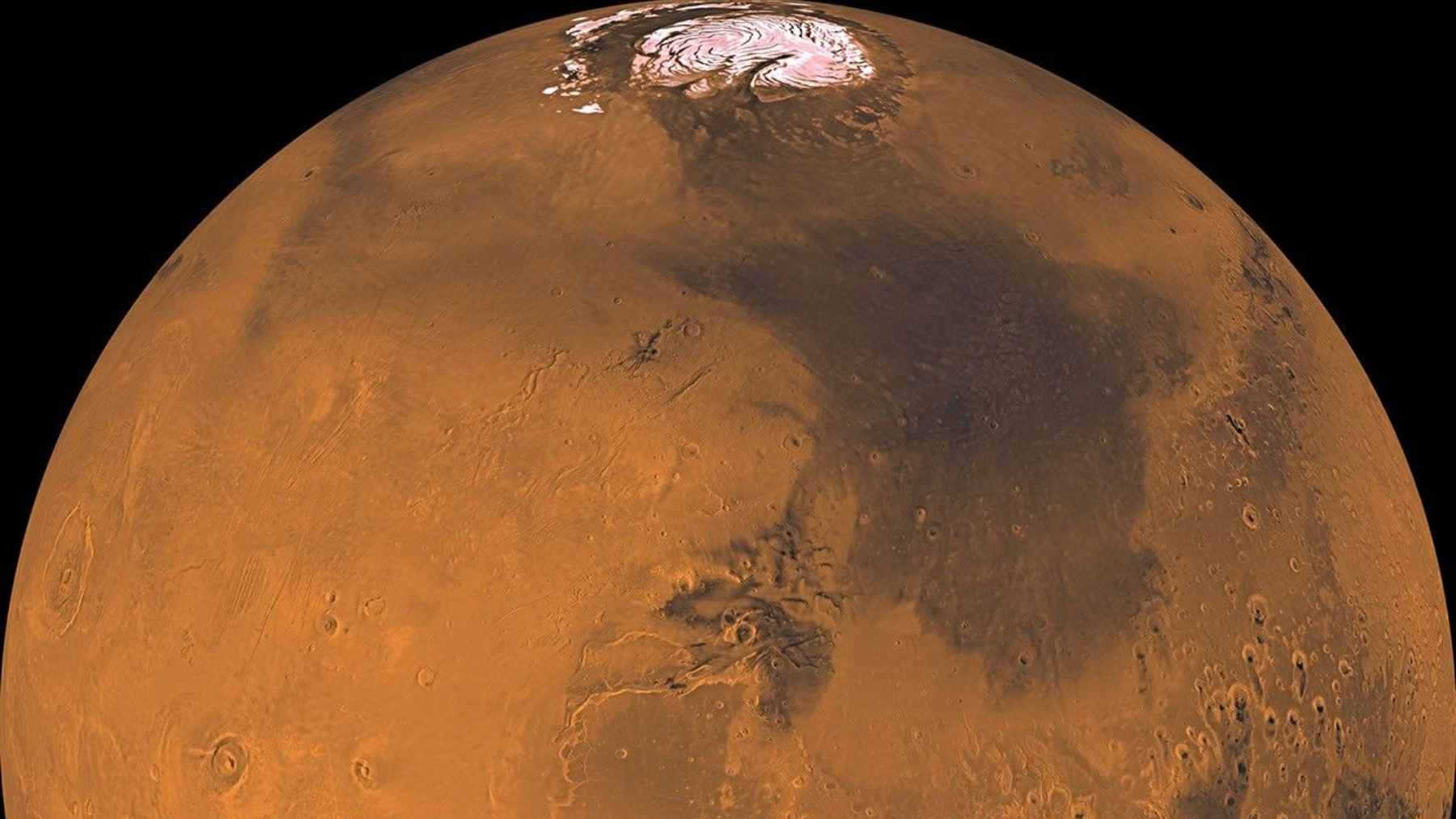
When people talk about what drives Earth’s climate, they usually point to greenhouse gases, volcanoes, or the Sun. Hardly anyone blames Mars. Yet new simulations show that Mars, though only about one tenth the mass of Earth, quietly helps set the timing of our planet’s ice ages by tugging on its orbit.
The work, led by planetary astrophysicist Stephen R. Kane at University of California, Riverside and published in Publications of the Astronomical Society of the Pacific, maps how changing the mass of Mars reshapes Earth’s slow orbital cycles that control incoming sunlight over millions of years.
A small neighbor with a long reach
These long-term variations, known as Milankovitch cycles, arise from subtle gravitational pulls between planets. Over tens of thousands to hundreds of thousands of years they change how stretched Earth’s orbit is and how much the planet tilts on its axis, pacing the growth and retreat of great ice sheets.
In Kane’s simulations, one especially important pattern, a grand cycle lasting about 2.4 million years, vanished whenever Mars was removed. A shorter cycle of roughly 100,000 also disappeared.
By contrast, a separate cycle of around 400,000 years, dominated by the combined pull of Venus and Jupiter, kept ticking regardless of what happened to Mars. Taken together, the results suggest that the red planet helps keep several of Earth’s key climate rhythms in place rather than letting them drift.
Turning the Mars knob
To test just how important Mars is, the team treated its mass like a dial on a control panel. In a suite of computer experiments they set Mars to zero, to its real value, and up to ten times heavier, then watched how Earth’s orbital shape and axial tilt evolved over millions of simulated years.
As Mars grew heavier in the models, the climate-related cycles linked to its gravity became stronger and some shifted to shorter periods.
The simulations also showed that a more massive Mars would make Earth’s tilt change more slowly, which tends to calm some extreme swings in which hemisphere gets more sunlight over time.
Kane has said he went into the project assuming Mars’s influence would be tiny and mainly wanted to check his own assumptions. The results convinced him otherwise. As he put it, “Without Mars, Earth’s orbit would be missing major climate cycles.”
He has also stressed that Earth would still have ice ages without Mars, only on a very different timetable and with different intensity.
What this means for climate and for other worlds
For daily life, all of this operates in the deep background. These planetary cycles unfold over tens of thousands of years or more, while human driven greenhouse gas emissions are changing temperatures on the scale of decades. Natural orbital rhythms still matter for when ice sheets grow or shrink, but they do not explain the rapid warming behind today’s heat waves, droughts, and rising electric bills.
The study also carries a message for planets beyond our own system. Astronomers already know that gravitational tugs between planets can shape long-term climate on Earthlike worlds.
Researchers such as Sean Raymond at University of Bordeaux have argued that generalized Milankovitch cycles could be a key piece of long-term habitability, tying climate stability to the full orbital layout of a system rather than just the distance of one planet from its star.
Kane’s Mars experiment offers a concrete example, showing how even a relatively small outer neighbor can quietly help decide whether a planet enjoys a steady climate or wilder swings over geologic time.
The study was published in Publications of the Astronomical Society of the Pacific.