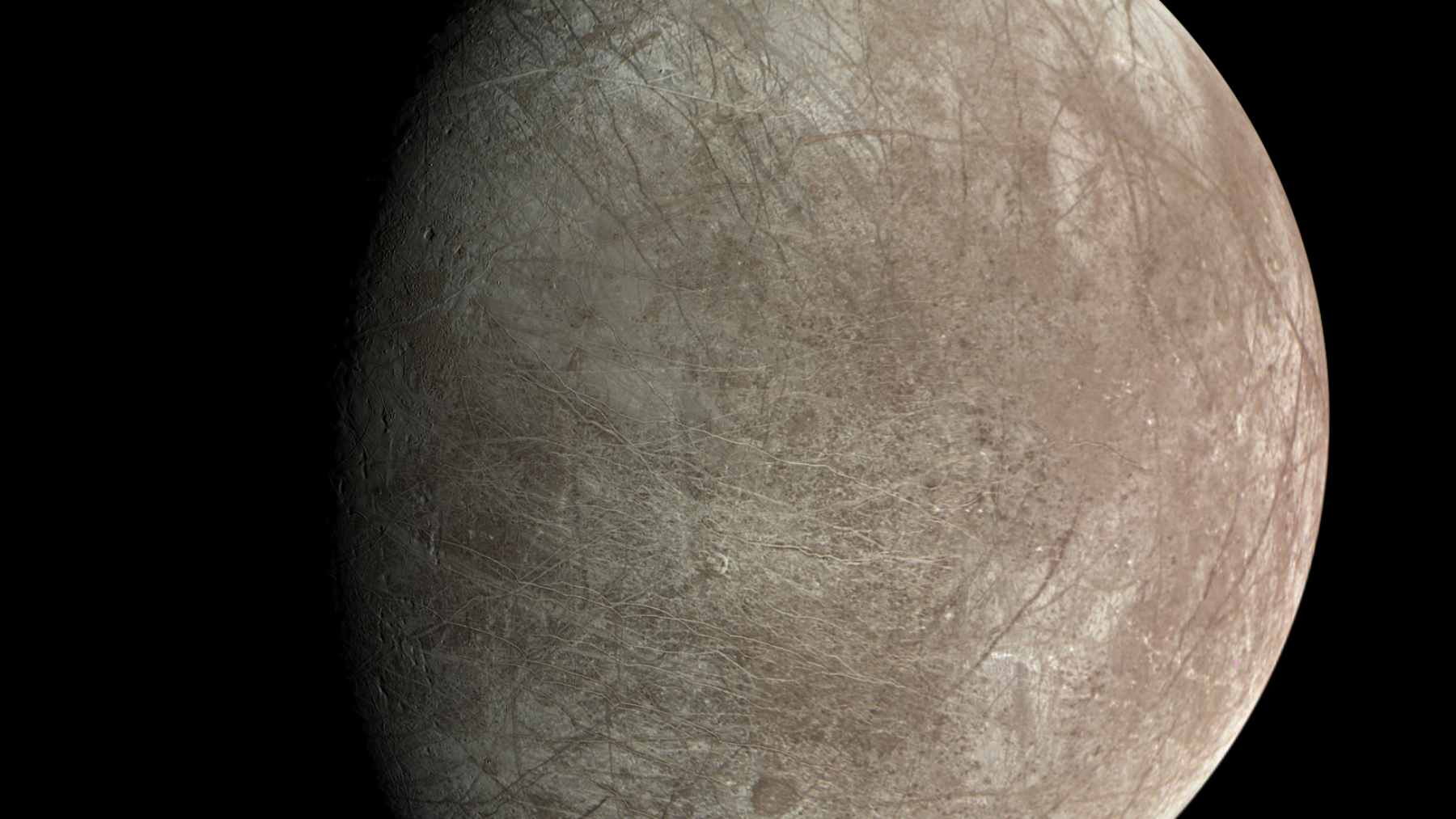
For years, Jupiter’s icy moon Europa has sat near the top of the “where could life be hiding” list. A salty global ocean, a thick ice shell, and constant tugging from giant planet gravity sounded like the recipe for an alien deep‑sea ecosystem.
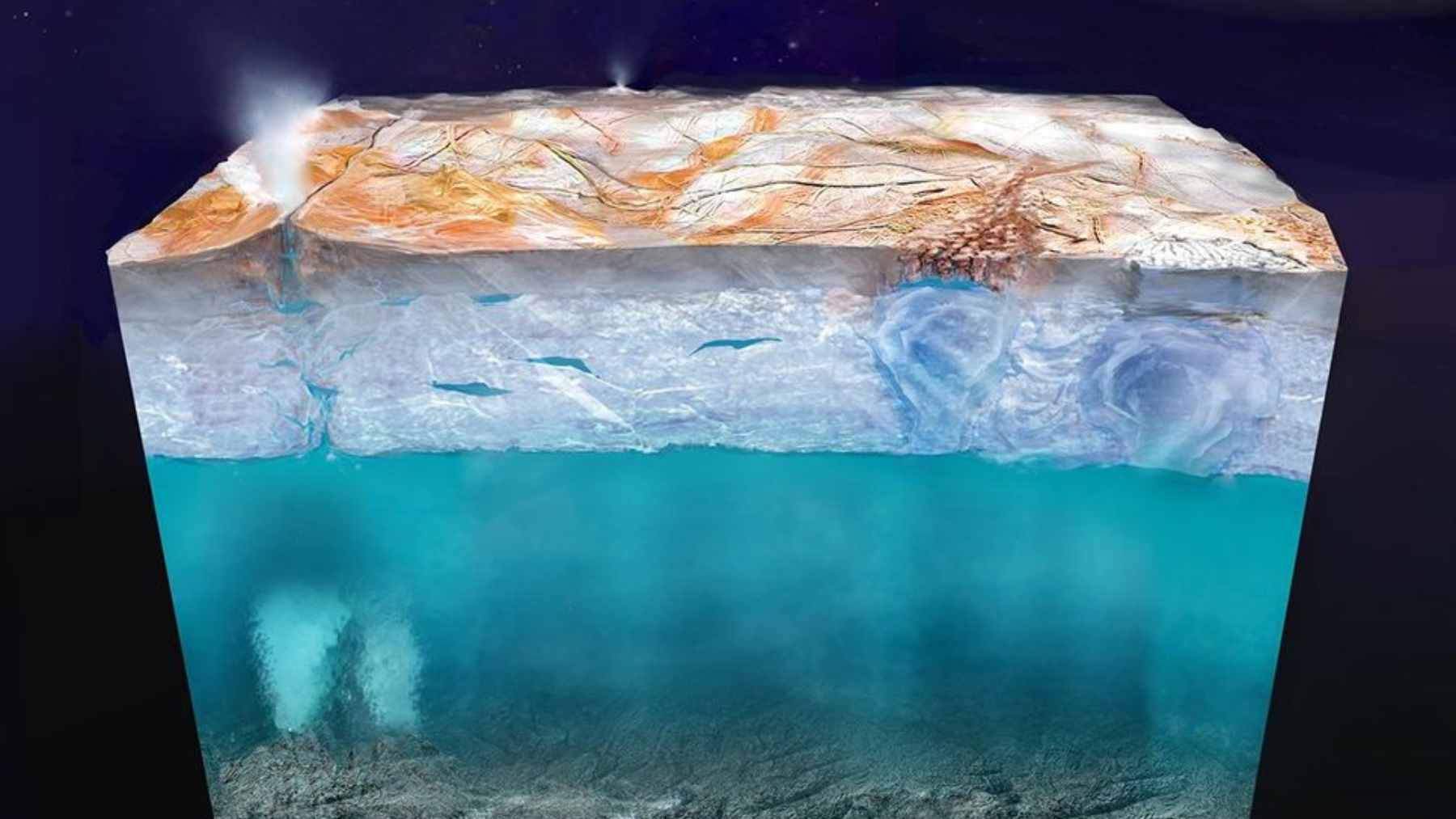
A new study now puts a serious question mark on that hopeful picture. Researchers modeling the interior of Europa found that its rocky seafloor is, for the most part, too strong and too stable to crack and move in the way Earth’s seafloor does.
That means little to no ongoing tectonic or volcanic activity at the bottom of Europa’s ocean today, and far fewer opportunities for water to react with fresh rock, release chemical energy, and feed microbes.
Why cracks in the seafloor matter for life
On Earth, life in the deep ocean thrives in some of the harshest places you can imagine. Along mid‑ocean ridges and around hydrothermal vents, tectonic forces continually break and bend the crust. Hot water seeps through fractures, reacts with rock, then gushes back out carrying hydrogen, methane, and other chemical “food” that bacteria and other organisms can use.
Planetary scientist Paul Byrne told Reuters that tectonic activity on Earth exposes fresh rock to seawater, where chemical reactions create compounds that microbes tap into. Without that constant churning, those reactions become much harder to sustain.
For Europa, scientists had long imagined something similar happening far below the ice. Picture black smokers and lava‑warmed seafloor, only under a frozen roof instead of open ocean. The new work suggests reality may be closer to a cold, mostly motionless seafloor with only shallow circulation.
A seafloor that barely budges
The team behind the study combined rock mechanics with models of Europa’s interior, using generous assumptions that actually make faulting easier.
They treated the seafloor rock as already altered and weakened by past reactions with water, riddled with pre‑existing fractures, and saturated with ocean water that helps reduce rock strength. Even with all those “easy mode” choices, the numbers did not cooperate.
Tidal flexing from Jupiter raises and lowers Europa’s icy shell every 84 hours. At the seafloor, that daily squeeze produces stresses of about tens of thousands of pascals. The rocks, however, would need stresses in the millions of pascals range to start slipping along fractures just a hundred meters below the ocean floor.
The researchers also tested other possible drivers, such as slow global shrinking of Europa’s rocky interior as it cools, internal convection in the mantle, and volume changes tied to rock hydration.
None could consistently overcome the strength of the lithosphere. Even convection in the interior would, at best, generate stresses that are more than a hundred times too weak to punch through the rigid lid above.
In everyday terms, think of a planet whose rocky floor behaves more like a locked‑in concrete slab than a shifting jigsaw of plates.
Their conclusion is blunt. Ocean water–rock reactions happening today are probably limited to fluid flow through only the upper few hundred meters of the seafloor. Any process that keeps the deep ocean habitable now has to work without active tectonics.
So does that mean Europa is lifeless?
Not necessarily, although the odds at the seafloor look worse than many scientists had hoped.
The study focuses on big, energetic processes like volcanism and large fault systems. It does not rule out small‑scale features such as microfractures in the upper crust or long‑lived but very slow circulation of water through porous rock.
Those gentler pathways could still enable limited water–rock reactions, just not with the same power as an Earth‑style hydrothermal vent field.
The authors also highlight another quiet but important energy source. Radioactive elements inside Europa’s rocks can split water molecules through a process called radiolysis, producing hydrogen, sulfate, and simple carbon compounds.
On Earth, similar reactions in ancient rocks help feed microbial communities deep underground, far from sunlight and plate boundaries.
If something similar is happening on Europa, a small chemosynthetic biosphere might still be possible, even with a calm seafloor. It would likely be less like a bustling reef and more like a sparse community living off a slow chemical trickle.
A habitable past and the Europa Clipper era
There is also the question of time. The new work looks at Europa today. It is still possible that the moon was far more geologically active billions of years ago, when radioactive heating was stronger and its orbit may have been different.
For a while, that could have created vigorous hydrothermal systems that gave any early life a better shot.
Even with these sobering results, space agencies are not crossing Europa off the list. NASA’s Europa Clipper spacecraft, launched in 2024, is on its way to the Jupiter system. Starting around 2030, it will perform nearly fifty close flybys to map the ice shell, measure the ocean, sniff out plumes, and search for chemical fingerprints of water–rock interactions, past or present.
At the end of the day, this study does not kill the dream of life in Europa’s ocean. It shifts the search. Instead of expecting roaring underwater volcanoes lighting up the abyss, scientists will be looking for subtler signs of energy, chemistry, and ancient activity that might still echo through the ice today.
The study was published in Nature Communications.