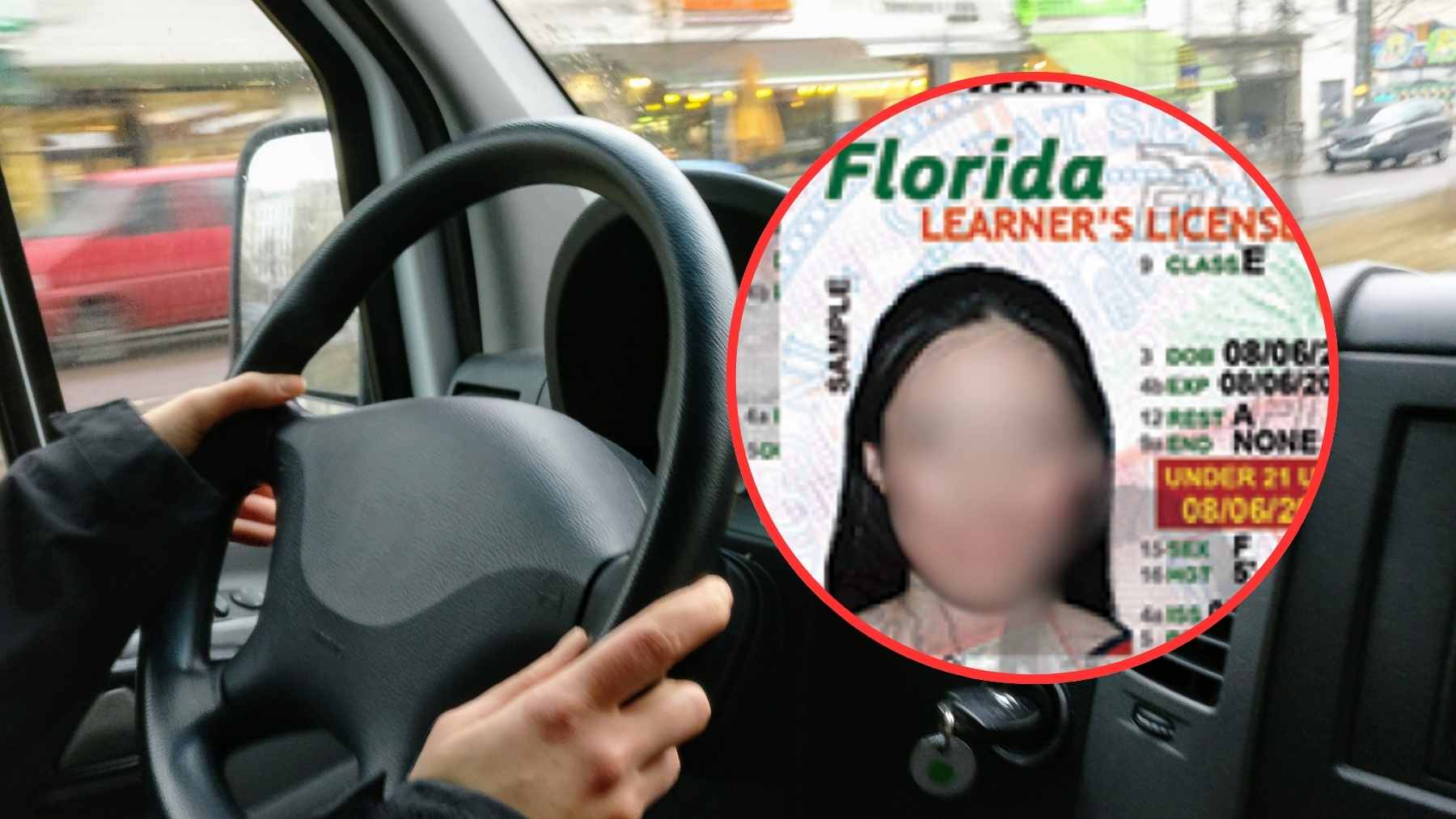
Starting today, every written, oral and road exam for a driver license in Florida is given in English only. No more Spanish, Haitian Creole, Portuguese or other options. No interpreters in the car during the skills test either. State leaders say this will make roads safer.
The evidence so far suggests the impact on crash risk may be small, while the impact on people’s lives could be quite large.
A new rule meets a human story
Daniela arrived at a Miami Dade tax collector office on Thursday holding paperwork that showed she had passed her driving exam in Spanish. She had taken the test through an authorized third party, completed the required course and had been told she could now pick up her physical license.
Instead, she was stopped in the hallway and told the state had randomly selected her for a mandatory retest.
That random retest is allowed under Florida law. Anyone who passes the Class E knowledge or skills exam with an outside provider can be chosen without warning to repeat the test at a state or county office before a license is issued.
For Daniela, the timing could not have been worse. By the time she learned she needed a new appointment, there were no openings left on the last day Spanish exams were allowed.
Starting this morning, all tests are English only, which means she cannot retake the exam until she feels ready in a language she is still learning. She told NBC 6 that she and her family “try to do everything the right way” yet each step feels more complicated.
Anyone who has juggled work schedules, childcare and long DMV lines can imagine how that day felt.
What exactly is changing
The Florida Department of Highway Safety and Motor Vehicles (FLHSMV) now requires every driver license knowledge and skills exam to be conducted in English. The rule applies to all license classes and to oral exams.
Translation devices and interpreter assistance are no longer permitted, and printed tests in other languages are being removed from service centers and from third party providers.
Until now, most non-commercial knowledge exams were offered in several languages, including Spanish and Haitian Creole, while commercial exams were already limited to English and Spanish.
Data from Hillsborough County show how many people rely on those options. In 2025, about 37% of skills tests there, more than thirteen thousand exams, were taken in languages other than English.
Florida is one of the most multilingual states in the country. Roughly three in ten residents over age five speak a language other than English at home, and about 35% of naturalized citizens report limited English proficiency.
Governor Ron DeSantis has praised the change as a “good reform” and argued that drivers “need to be able to read the road signs.” Critics, including Democratic Party chair Nikki Fried, say the policy is less about safety and more about targeting immigrant communities.
Safety claims meet thin data
So will English-only tests really make highways safer? A detailed review by PolitiFact and NBC 6 found no academic studies or government reports showing that people who take driving exams in other languages cause more crashes than those who test in English.
Major traffic safety groups, including the National Safety Council, the Insurance Institute for Highway Safety, the American Association of Motor Vehicle Administrators and AAA Foundation for Traffic Safety, told fact checkers they were not aware of such research.
Most crash risk studies point to age, driving experience and behavior, especially distraction and impairment, as the strongest predictors of serious collisions.
Experts also note that modern road signs are designed around shapes, colors and symbols that work regardless of a driver’s native language. A standard red octagon usually sends the message on its own.
Guidelines from the American Association of Motor Vehicle Administrators go further. They state that an inability to read or speak English is “not necessarily a barrier” to safe driving as long as someone can interpret signs, signals and markings and still meets knowledge requirements.
The same guidelines warn that when non English speakers cannot pass licensing exams, they may be more likely to drive without a license or seek fraudulent paperwork.
In other words, a strict language rule may reduce the number of licensed, insured drivers more than it reduces risky driving.
Everyday consequences on Florida roads
Local tax collectors and instructors are already bracing for that tension between policy and reality. In a public notice, the Hillsborough County tax collector said the office is required to follow FLHSMV directives but acknowledged the change “may present real challenges” for a diverse community.
Driving school owners interviewed in local coverage worry that some residents will still get behind the wheel to reach work, school or medical appointments, even if they can no longer clear the English exam. That could mean more unlicensed and uninsured drivers sharing the same rush-hour traffic that everyone else sits in.
Traffic safety specialists point to other tools with stronger track records, such as increasing supervised practice hours for new drivers and tightening graduated licensing rules for teens.
Those measures have repeatedly been linked with lower crash rates in studies from children’s hospitals and international journals.
For now, anyone hoping to get a Florida license must prepare to study the English language driver handbook, practice test questions and the scripted instructions examiners give during the road test. For people like Daniela, that adds months of delay and extra stress to a process that already strains time, money and patience.
The official statement was published by the Florida Department of Highway Safety and Motor Vehicles.