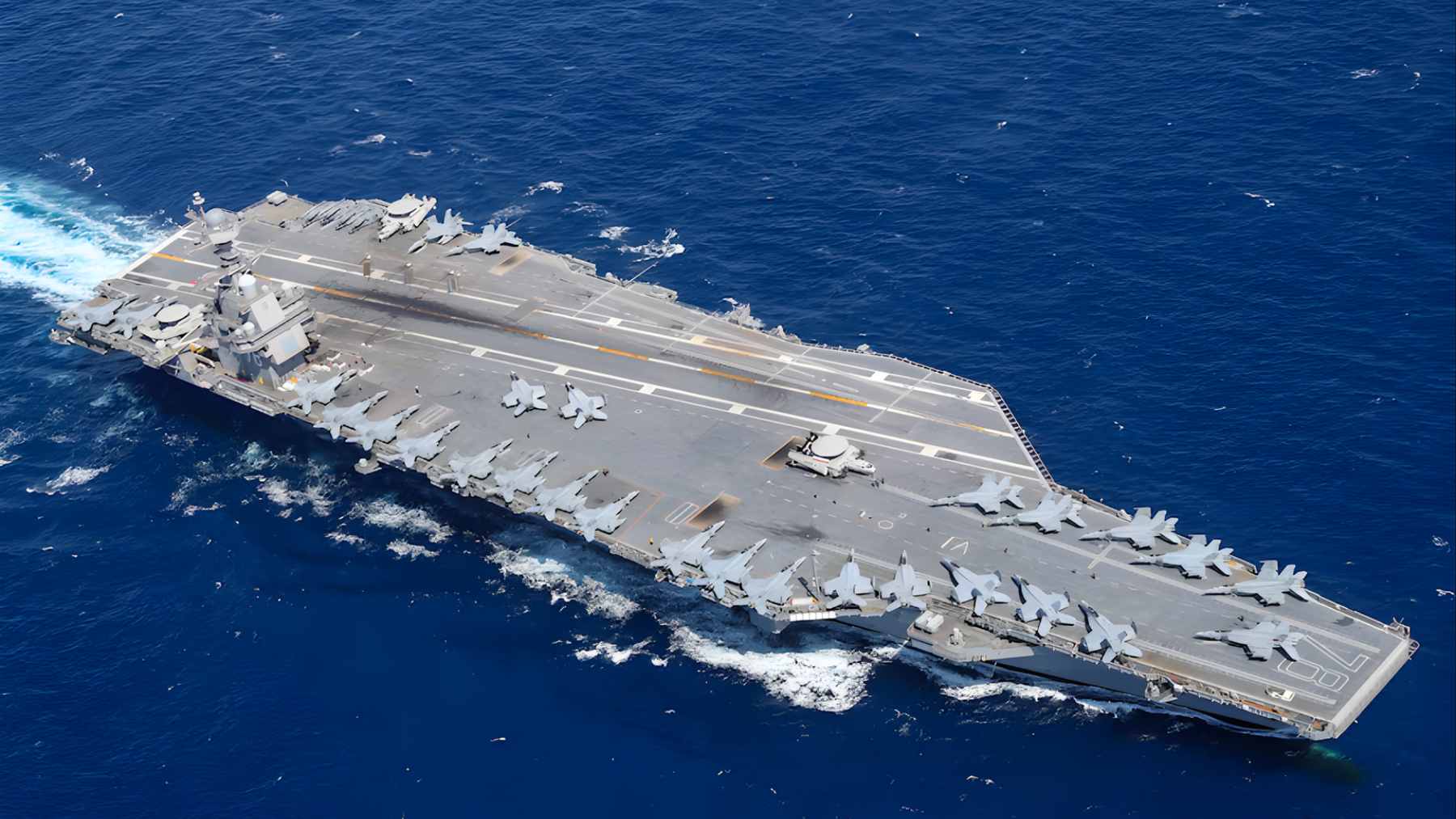
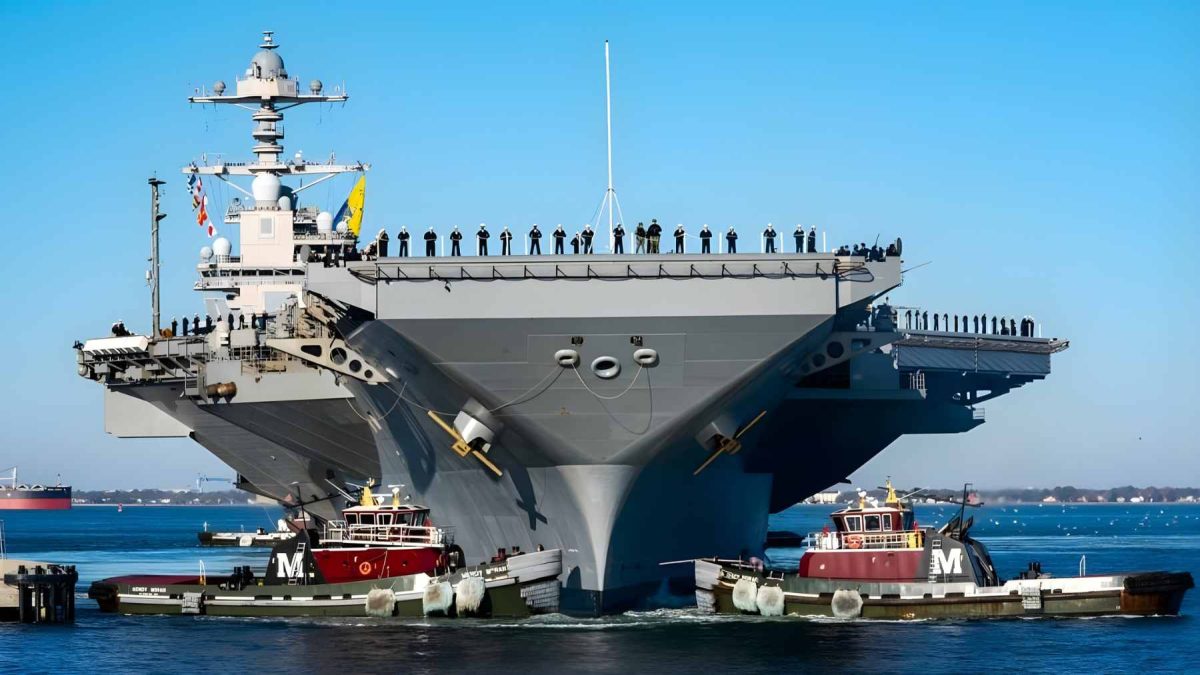
On paper, the nuclear-powered aircraft carrier USS Gerald R. Ford is the most advanced warship ever built, with a price tag of around 13 billion dollars and a crew of more than 4,500 sailors. In practice, life on board is being disrupted by something far more mundane than hypersonic missiles or radars. It is the toilets.
Internal Navy emails and oversight reports show that the ship’s high-tech sewage network suffers constant failures, forcing sailors to queue for working bathrooms and maintenance crews to chase clogs almost every day since mid-2023.
A vacuum toilet system that keeps breaking
Instead of a traditional gravity-based system, the Ford uses a Vacuum Collection, Holding and Transfer setup. Powerful pumps create suction that pulls waste through narrow pipes spread across roughly ten independent zones to more than six hundred toilets.
The concept is similar to the sharp flush people hear on an airliner and was adapted from cruise ships to save water on long deployments.
On a busy warship, that elegant idea has turned brittle. Documents obtained by NPR show that in March 2025 alone, the Ford logged 205 toilet breakdowns in just four days and called for outside technical help 42 times between 2023 and 2025.
One faulty valve or small leak can knock out all the toilets in an entire zone at once, leaving long lines of sailors waiting in passageways instead of focusing on flight operations or maintenance.
Anyone who has dealt with a single clogged toilet at home can imagine the stress when hundreds of fixtures start to fail in what is essentially a small floating city.
Seawater, calcium and $400,000 repairs
The root of the problem is not only what sailors flush. The system uses seawater for each flush, which then mixes with urine. In marine plumbing, that combination is notorious. It causes calcium compounds to precipitate and slowly coat the inside of pipes, shrinking their diameter and eventually choking the flow.
In a 2020 shipbuilding audit, the Government Accountability Office warned that the new sewage systems on carriers CVN 77 and CVN 78 were experiencing what it called “unexpected and frequent clogging”.
To keep the pipes open, the Navy determined that it would have to perform full system acid flushes throughout the ships’ service lives. Each of those treatments costs about $400,000 and is classified as unplanned maintenance.
Navy emails cited by public radio reporters indicate that the Ford has already undergone at least ten of these acid cleanings since 2023. The process uses strong chemicals to dissolve calcium deposits and, according to officials quoted by regional public media, it can only be carried out in port for safety and environmental reasons.
For a nuclear-powered carrier designed to stay at sea for long stretches without refueling, depending on shore facilities simply to keep toilets working is more than an embarrassment. It quietly limits flexibility.
Gender-neutral bathrooms and fewer fixtures
The Ford’s plumbing experiment does not end with vacuum pipes. It is also the first US carrier to sail with entirely gender neutral bathrooms, which means there are no urinals anywhere on the ship. The idea was to make it easier to reassign berthing spaces as the share of women in the crew grows.
That choice has its own side effects. Restroom designer Chuck Kaufman, who led the Public Restroom Company, told Navy reporters that a standard sit down toilet is “by far a less clean environment than a urinal” and that each one takes more than twice as much floor space as a wall-mounted unit.
In practical terms, that means fewer fixtures in the same footprint and slower bathroom traffic during busy periods. Anyone who has spent halftime in a stadium restroom recognizes the pattern.
A cautionary tale for future warships
The Ford is not the first ship to struggle with this system. The earlier carrier USS George H. W. Bush suffered similar failures on its maiden deployment, with all 423 toilets reported out of service twice in one year and roughly 10,000 work hours spent on repairs.
For the most part, Navy leaders insist that the plumbing issues have not affected the carrier’s combat missions, and upgrades to the vacuum network are planned during upcoming maintenance periods.
Yet even by the Navy’s own estimates, the acid flushes and extra repair work will keep adding costs for decades, on top of an already expensive ship class.
At the end of the day, the Ford’s toilet trouble is not just a curiosity. It shows how a system that looks efficient on paper can become fragile when scaled up for thousands of people working under pressure. Saving water with a sleek vacuum design sounds modern.
Having crews work nineteen-hour days to track leaks, while planners budget hundreds of thousands of dollars per cleaning cycle, feels much less so.
The shipbuilding study that first detailed these toilet problems was published by the Government Accountability Office.