Along the north rim of Yellowstone’s vast caldera, the ground has quietly lifted by about two centimeters since July 2025. For a supervolcano that stars in so many end-of-the-world videos, that might sound scary. In practice, it fits a long record of gentle breathing by the volcano rather than a warning that an eruption is close.
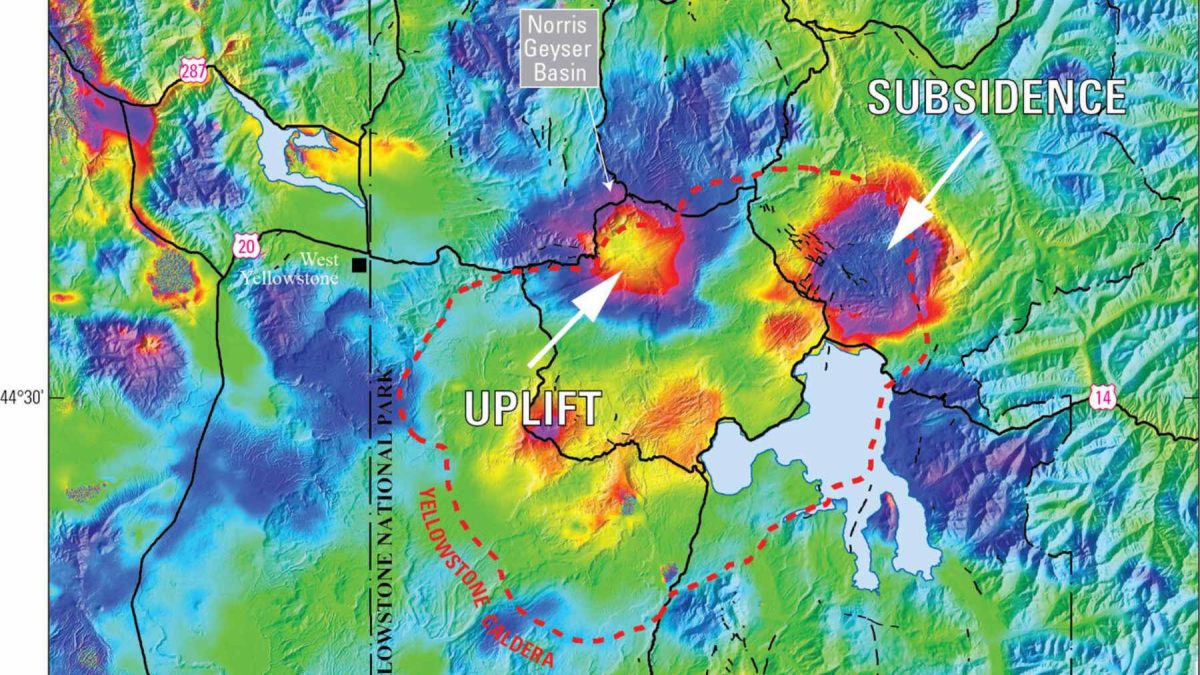
The rising zone sits just south of Norris Geyser Basin and has a name that fits its personality. Scientists call it the Norris Uplift Anomaly, an area that also swelled between 1996 and 2004 before slowly sinking again.
This time the patch of uplift spans many kilometers and has even been compared in footprint to a city the size of Chicago, yet the total motion is less than an inch.
GPS and satellite radar tracking Yellowstone ground deformation
You would not notice that change when you pull into a crowded trailhead parking lot. Highly sensitive instruments do. A network of continuous and seasonal GPS stations along with satellite radar interferometry has tracked the ground inching upward and outward, much like an inflating balloon deep underground.
From July to early autumn 2025, GPS near the center of the anomaly recorded about two centimeters of uplift, and radar images over the same period show a neat bullseye pattern that matches that rise.
Magma movement and why scientists are not expecting an eruption
What is pushing the surface up? USGS modeling points to a source about fourteen kilometers beneath the park, deeper than Yellowstone’s shallow hydrothermal system. That depth and the circular pattern of deformation are most consistent with magma slowly accumulating in part of the crust.
At the same time, the broader magma chamber remains mostly solid, and uplift of this size does not change the overall eruption odds. Before any dangerous activity, scientists would expect much faster and shallower deformation, sharp jumps in earthquake activity, and clear changes in gas and heat output.
Yellowstone earthquakes and hydrothermal hazards
Seismometers tell a similar story. Yellowstone logged a little over 1,100 earthquakes in 2025, mostly tiny events clustered in the northwest part of the park and around the uplift. That total sits on the low side of the usual 1,500 to 2,500 quakes that rattle the region each year.
The strongest hazards on human time scales remain familiar ones such as large tectonic earthquakes like the 1959 Hebgen Lake event and sudden hydrothermal explosions that can rearrange a boardwalk overnight.
New research on Yellowstone’s magma reservoirs
Behind the scenes, new research is filling in the picture of Yellowstone’s interior. Magnetotelluric imaging and related studies show that the main rhyolite magma reservoirs contain only single-digit to low-teen percentages of molten rock, far below the levels needed to feed a huge explosive eruption.
The largest body of melt sits beneath the northeast part of the caldera, and even there scientists describe the system as mostly a hot, crystalline mush rather than a vast underground lake of liquid magma.
So what does the Chicago-sized bulge really mean for the millions of visitors who come for bison jams, steaming pools, and that sulfur smell in their clothes? To a large extent, it reflects the normal, restless behavior of a living volcanic system and the remarkable ability of modern monitoring networks to spot movements smaller than the thickness of a smartphone.
The official statement was published by the U.S. Geological Survey.