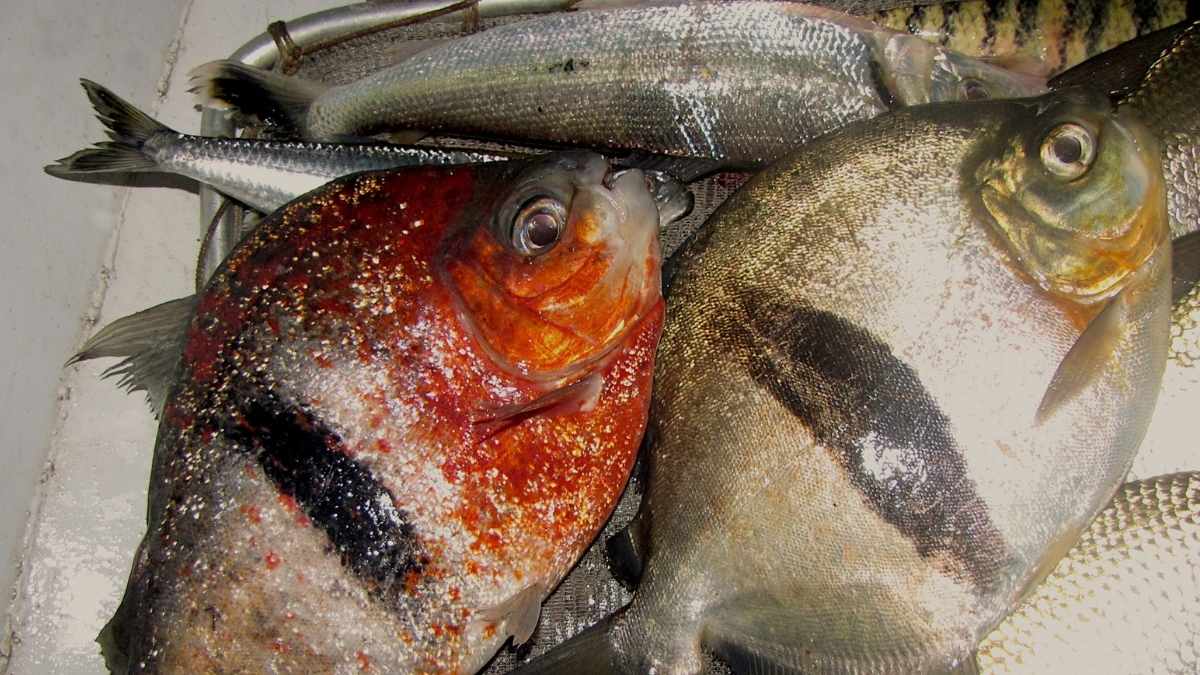
The black vertical stripe that makes the “black‑barred” pacu easy to spot has hidden a bigger story. A new peer‑reviewed study shows that what many people treated as one species is actually three, split by both DNA and anatomy across the Amazon and Orinoco basins.
The research was led by Vinícius N. Machado and Victor D. Pereira at the Federal University of Amazonas, in collaboration with colleagues at the National Institute of Amazonian Research and the Academy of Natural Sciences in Philadelphia. The team redescribed the well‑known Myloplus schomburgkii, designated a new official reference specimen, and named two species new to science. The findings have important implications for conservation, fisheries management, and the scientific classification of pacus and their relatives.
What scientists found
The researchers confirm that the fish long sold and studied as Myloplus schomburgkii is only one of three look‑alike species marked by a dark vertical bar on the side. The other two, Myloplus aylan and Myloplus sauron, were hidden in plain sight because their body shape and color overlap with the classic fish.
The three lineages show clear genetic gaps. Their DNA differs by roughly eight to eleven percent, a wide separation for fishes. That genetic split corresponds to consistent differences in the bar’s shape, fin details, and bone counts that help field biologists tell them apart.
How the team figured it out
The group used DNA barcoding alongside detailed measurements of bones, scales, and fins. The approach builds on a broad 2018 research effort that scanned more than a thousand pacus and piranhas across the region and hinted at hidden diversity inside black‑barred pacus.
They also checked the family tree with recent genomic work. A 2020 phylogenomics study showed that the black‑barred pacus do not cluster in a single neat branch; one of the new species sits next to Ossubtus xinguense on the family tree. That result supports a broader rethink of pacu groupings.
Where these fish live and how to tell them apart
Myloplus schomburgkii ranges across clear‑ and black‑water tributaries from the Negro and Branco to parts of the Tapajós and Xingu. Myloplus aylan favors black‑water or clear‑water habitats in western Amazonia. Myloplus sauron lives in fast‑flowing reaches of the Xingu basin, a river where hydropower construction has changed river flow and rapids habitats in recent years.
On the fish, the telltale stripe varies. In M. schomburgkii the vertical bar keeps a more uniform width. In M. aylan it widens near the lateral line. In M. sauron it narrows toward both ends. Females and young also show different anal‑fin shapes that help with identification.
Why this matters for people and rivers
Accurate species identification is crucial for establishing effective rules governing harvest, trade, and the design of protected areas. The authors note local pressures where these fish occur, including mercury contamination linked to mining in parts of the Branco basin. In Peru, the species now called M. aylan is subject to a fishing rule that allows extraction only under approved management programs.
Based on what is known today, the team says a broad threat listing would likely remain “Least Concern” under IUCN categories and criteria, but finer‑scale management is still needed.
What a neotype is and why it matters here
Scientists rely on name‑bearing specimens to anchor each species’ identity. A “neotype” is a replacement reference chosen when the original type is missing, under rules set by the International Code of Zoological Nomenclature. For clarity, the authors selected a neotype of M. schomburgkii from the Negro River at Barcelos and fixed that locality as the standard for future comparisons.
The official study has been published in Neotropical Ichthyology.