Astronomers have confirmed a strange kind of object in our cosmic neighborhood. About 14 million light years from Earth, near the spiral galaxy M94, sits Cloud-9, a compact cloud of hydrogen gas that behaves like a small galaxy yet contains no detectable stars at all.
That may sound like a cosmic glitch. In reality, it is exactly what leading theories of how the universe grows have been predicting for years.
A galaxy that never turned its lights on
Cloud-9 is filled with neutral hydrogen that shines in radio waves and weighs in at roughly one million times the mass of our Sun. Its gas is cold and slow moving, with a very narrow spread in velocities of about 12 kilometers per second.
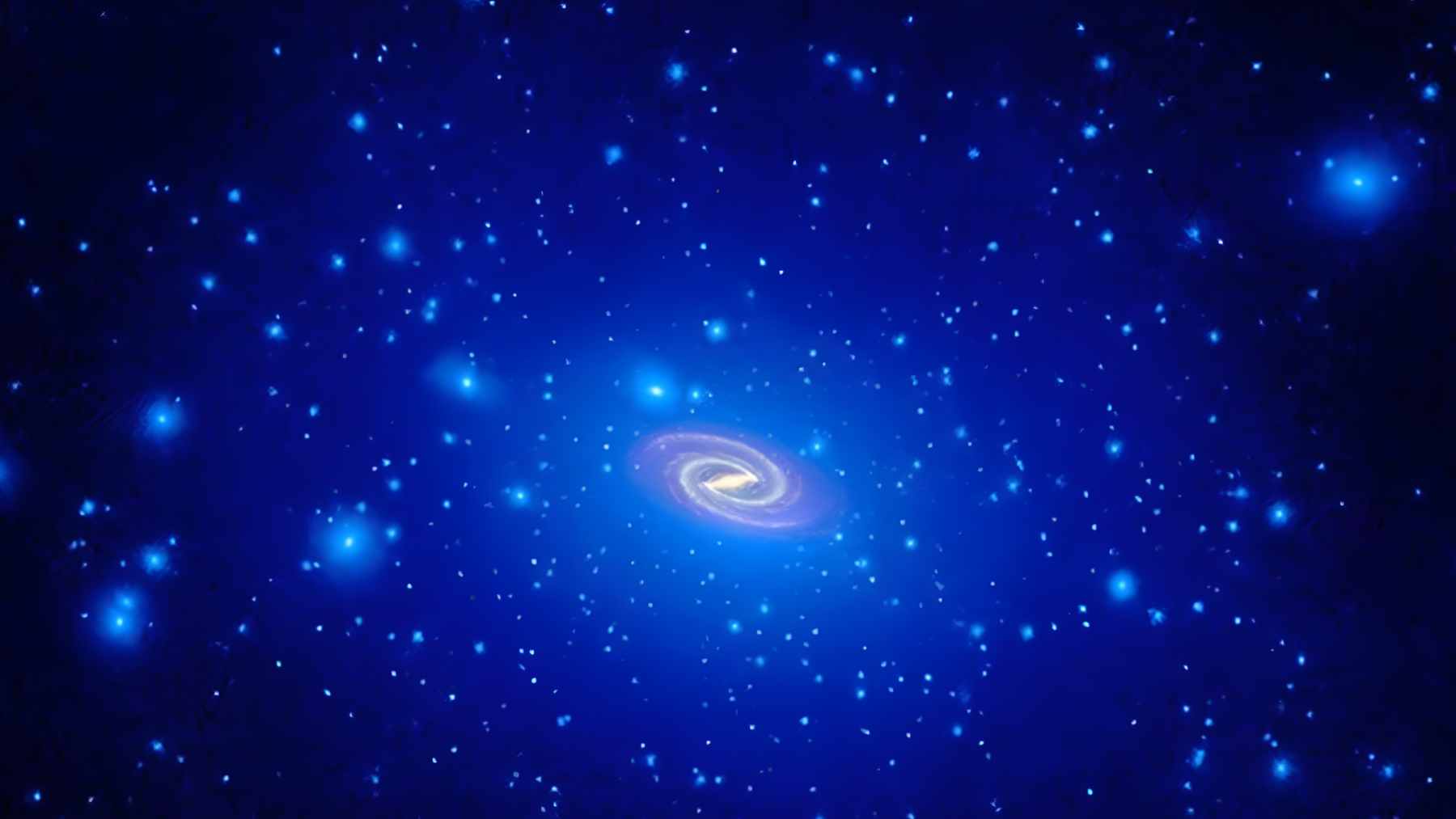
Those calm motions only make sense if the cloud is sitting inside something much heavier. By matching the gas profile to computer models, the team estimates that Cloud-9 lives in a dark matter halo about five billion times the mass of the Sun, right on the edge of the minimum mass where galaxies can form stars today.
In other words, this is a galaxy that had the gravity needed to hold on to gas, but not quite enough to ignite a proper stellar population. A failed galaxy.
What on Earth is a RELHIC?
The object fits the description of a reionization limited hydrogen cloud, or RELHIC. These are dark matter halos that kept some of their gas after the universe lit up with ultraviolet radiation from the first stars and galaxies.
That background radiation heats and “puffs up” gas in small halos, stopping it from collapsing into new stars.
For years, simulations based on the Lambda cold dark matter model have suggested that many such halos should exist. Most would be completely invisible.
A few of the heavier ones should keep a dense ball of neutral hydrogen at their center, bright enough in radio surveys to stand out as compact gas clouds with very narrow spectral lines. Cloud-9 is the first case where observations line up cleanly with that prediction.
So why are astronomers so excited about what looks like an empty patch of sky?
Hubble stares into the dark
Cloud-9 was first spotted with China’s Five-hundred-meter Aperture Spherical Telescope, then confirmed by the Very Large Array and the Green Bank Telescope, which all saw the same tight ball of hydrogen gas at essentially the same distance as M94.
From the ground, there was still room for doubt. Perhaps there was a tiny, ultra-faint dwarf galaxy hiding inside, with too few stars for earlier cameras to see. To settle that question, the team pointed the Advanced Camera for Surveys on the Hubble Space Telescope straight at the radio peak of Cloud-9 and took deep images in two filters.
If there were a normal dwarf galaxy there, even a very small one, Hubble should have picked up dozens of individual stars. Instead, the field looks almost empty. Using detailed simulations of what different dwarf galaxies would look like at that distance, the researchers show that any stellar population more massive than about three thousand Suns should have been detected.
A galaxy ten thousand solar masses in stars is ruled out with more than 99 percent confidence.
The few specks of light inside the cloud’s outline turn out to be background galaxies, not members of Cloud-9 at all.
A rare window into the dark universe
That near total absence of stars makes Cloud-9 an extreme outlier. Dwarf systems with a similar amount of hydrogen, such as Leo T or Leo P, usually have enough stars that the mass in gas and stars is of the same order of magnitude. Cloud-9 instead has at least four hundred times more hydrogen than any possible stellar content.
For cosmologists, this is a gift. Because the gas is not spinning in a disk but sitting in pressure supported equilibrium inside the dark matter halo, its structure offers a relatively clean probe of how dark matter is distributed on small scales. It is like finding a laboratory sample of the invisible scaffolding that holds galaxies together.
Researchers also checked more mundane explanations. Could Cloud-9 simply be a stray clump of gas from the Milky Way, or part of the Magellanic Stream that wraps around our galaxy. Its positive velocity and position on the sky make both ideas unlikely.
A gas cloud confined only by the hot atmosphere of M94 would probably be shredded in a short time, while Cloud-9 appears stable enough to survive for far longer.
What comes next?
Astronomers now want to know whether Cloud-9 is one oddball or the tip of a hidden population. Deeper imaging with future observatories, along with more sensitive radio surveys, could uncover other dark halos that never quite managed to switch on their stars.
As one team member put it, the local universe may contain a few “abandoned houses” in between its bright galactic cities.
Each new find would tighten our picture of how and where galaxies fail to form, and how dark matter shapes the cosmic landscape we live in.
The study was published in The Astrophysical Journal Letters.