When a trawler docked in the South African port of East London just before Christmas in 1938, no one on board imagined they were carrying a scientific time traveler. The strange blue fish set aside for a local museum curator looked like an odd catch from deep water.
On paper, though, it belonged to a family that textbooks said had vanished along with the dinosaurs around sixty six million years ago.
That is the twist. The species was not extinct at all. It had simply been hiding in the dark, far below the everyday churn of fishing nets and shipping lanes.
A museum phone call that rewrote an extinction story
Marjorie Courtenay Latimer, curator of the East London Museum, had asked local fishermen to call her whenever something unusual appeared in their nets. In December 1938, captain Hendrik Goosen did just that.
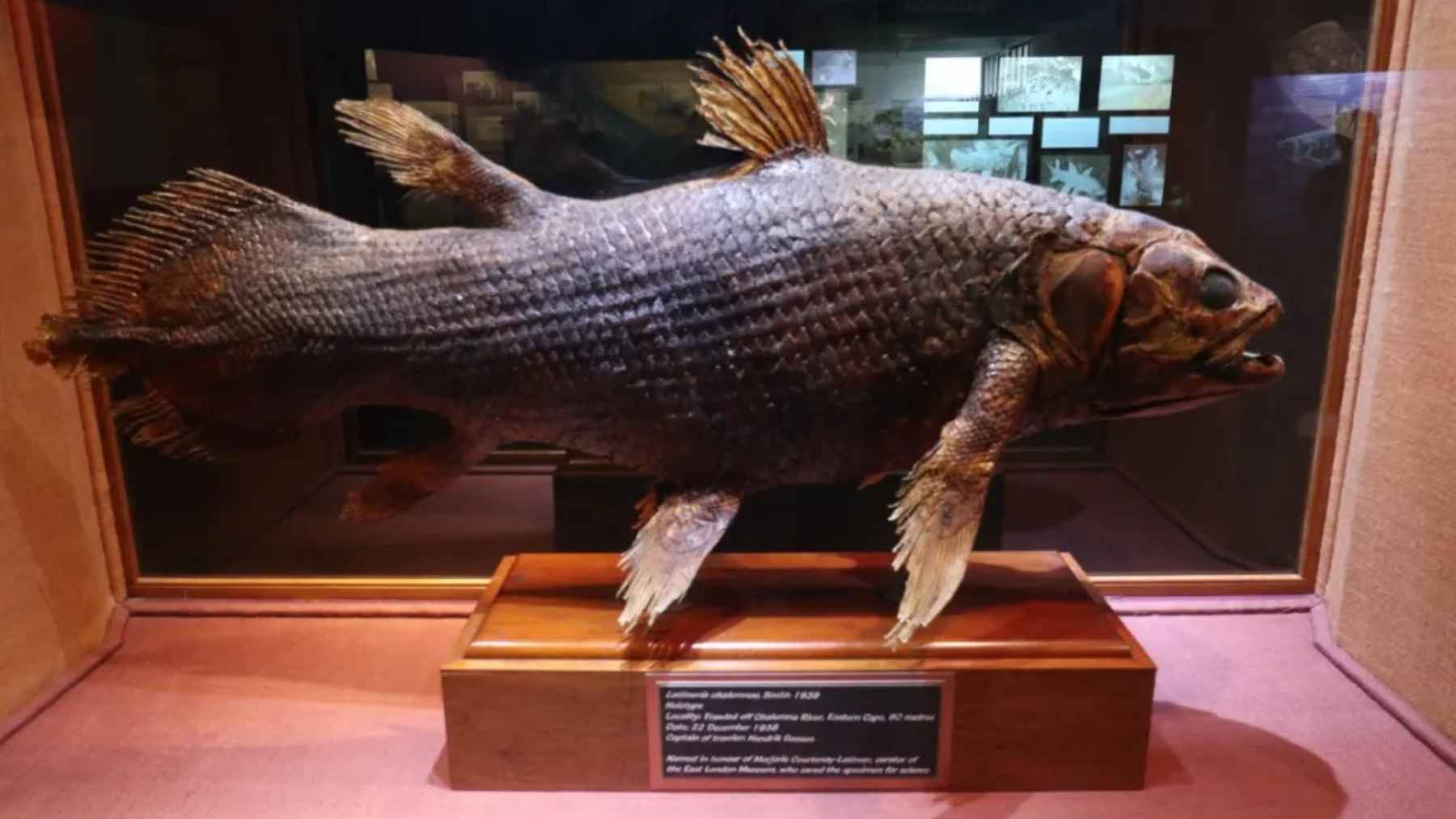
When Courtenay Latimer reached the dock and pulled back the layer of slime covering the fish, she later recalled thinking she was looking at “the most beautiful fish I had ever seen.” Thick, armor like scales, fleshy lobed fins, and a pale speckled blue body did not match anything in her reference books.
With no freezer available in the summer heat and the fish already beginning to rot, she made a practical but crucial choice. She had the animal preserved by a taxidermist rather than discarded. Weeks later she sent detailed notes and a sketch to ichthyologist James Leonard Brierley Smith at Rhodes University.
When Smith finally saw the specimen in early 1939, he is reported to have frozen on the spot and said there was no doubt. It was a true coelacanth, a member of a group known only from fossils that reached back hundreds of millions of years.
The species would be named Latimeria chalumnae in her honor and in reference to the nearby Chalumna River.
A fossil fish alive in the deep ocean
Before that dockside surprise, coelacanths were the kind of animal students met only in diagrams of ancient oceans. Their lobe-like fins, supported by bone inside, made them important for understanding how the first vertebrates with limbs emerged from the water.
Finding a living relative changed the story in an instant. Instead of being a symbol of failure and extinction, the coelacanth became a case study in survival at the edge of what we can observe.
Later work showed that Latimeria chalumnae lives along steep submarine slopes and canyon walls, often between roughly one hundred fifty and seven hundred meters deep, where colder, oxygen-rich water and rocky caves offer shelter.
Conservation databases such as the Global Biodiversity Information Facility list it as a distinct species with a very limited range and highlight its evolutionary importance. You can see that classification on its GBIF species page.
For decades, most confirmed specimens came from the Comoros Islands and nearby parts of the western Indian Ocean.
Then another surprise arrived from the opposite side of the basin. In the late 1990s, scientists working in Indonesia documented a second living species, Latimeria menadoensis, which differs in color and genetics and now has its own entry on the IUCN Red List.
From “living fossil” to critically endangered species
As the catches and underwater sightings accumulated, one uncomfortable pattern appeared. There were not many coelacanths. Most were hauled up accidentally in deep gill nets. Others turned up dead at the surface with their stomachs full of plastic or with smaller fish lodged in their mouths.
Modern assessments describe Latimeria chalumnae as critically endangered, with small populations scattered along parts of the African coast and around islands in the western Indian Ocean.
A specimen in the collections of the Natural History Museum of Denmark, cataloged together with its threat status, points directly to the Red List entry that classifies the species as critically endangered.
International rules have tried to move faster than demand. The entire genus Latimeria is now listed in Appendix I of the Convention on International Trade in Endangered Species, which effectively bans commercial trade in wild caught coelacanths.
That status is laid out in an official CITES proposal document that reviewed both African and Indonesian populations.
In parallel, research programs have grown around the fish and its environment. The African Coelacanth Ecosystem Programme, coordinated by the South African Institute for Aquatic Biodiversity, uses research vessels, submersibles, and remotely operated vehicles to map habitats and track individuals.
The programme’s own site, ACEP, describes how it expanded from a single discovery off Sodwana Bay into a long-term platform for east African marine science.
Why this near miss still matters
The coelacanth story sounds almost cinematic. A lone curator with sharp eyes, a nervous phone call from a fishing boat, and a specimen rescued just in time from the trash. Yet to a large extent, that is why it still matters. The rediscovery shows how easily a species can slip through the cracks when it lives at the limit of our tools and attention.
Biologists sometimes talk about “Lazarus species,” organisms that vanish from the record for decades or centuries and then suddenly reappear.
In recent years, that list has grown to include a giant Galapagos tortoise once believed extinct and several new frog and gecko species that turned up in a remote island boulder field after targeted night surveys, as covered in a science report on hidden jungle fauna.
On the other hand, discoveries like these do not erase the broader trend. Many lineages never get a second chance.
Some research suggests that even the toughest survivors on Earth, microscopic animals that can shrug off radiation and vacuum, will eventually lose their refuge when the oceans themselves disappear, a point explored in work on extreme resilience summarized in an article about the last living thing to become extinct on Earth.
The oceans still hide their secrets
If a five-foot-long, steel blue fish with armor plates can stay out of sight for tens of millions of years, what else are we missing in places we rarely look? Deep submarine canyons, lava-covered islands, isolated forests that appear to “come back to life” on their own, and even lunar landscapes are all reminding scientists that long-held assumptions can flip almost overnight.
You can see that same pattern in recent work on lunar carbon that overturned the idea of a “carbon poor” Moon, as explained in a report on natural graphene found in lunar dust.
For everyday readers, the coelacanth’s return is a nudge to look twice at humble details. A strange fish at the market, an odd shell on the beach, or an unusual pattern on a satellite map may be less boring than they seem at first glance.
For scientists and conservation agencies, it is a case study in how field work, museum collections, strict trade rules, and long term monitoring all have to work together if we want rare species to outlive our mistakes.
The commentary that revisits this history, documents new sightings off South Africa, and calls for stronger marine research and citizen science was published in the South African Journal of Science.