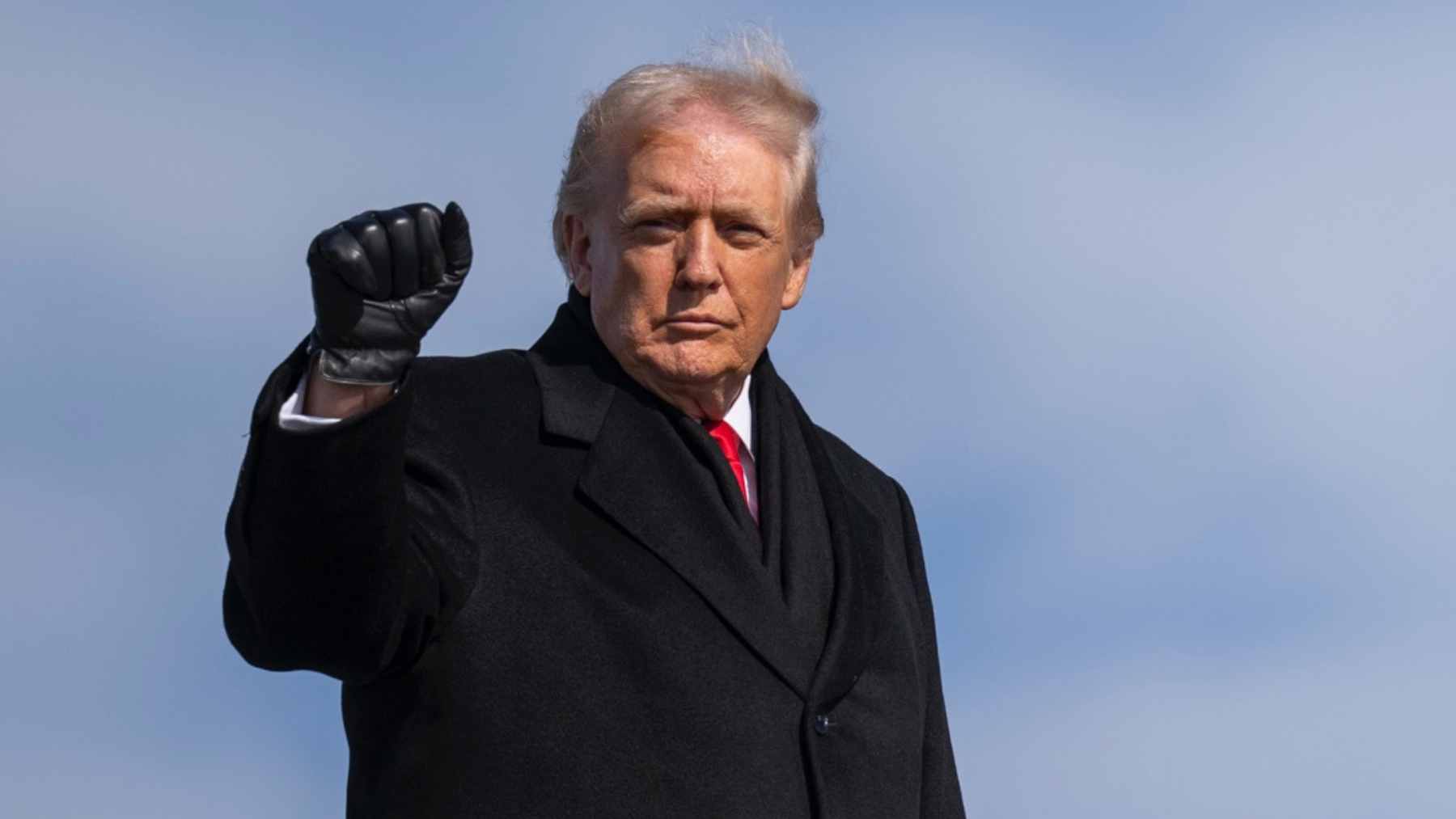
US President Donald Trump has drawn a stark line with Iran. Either Tehran accepts new limits on its nuclear program, he says, or the world may soon learn whether the Iranian supreme leader is serious when he warns that any US strike would ignite a regional war.
The warning comes as an American carrier strike group led by the USS Abraham Lincoln steams toward the Gulf, accompanied by guided missile destroyers and reinforced air defenses. US officials say the deployment expands Washington’s options both to shield its forces and to conduct further strikes if ordered.
A duel of warnings in public view
On Sunday, reporters asked Trump about remarks from Ayatollah Ali Khamenei, who told a crowd in Tehran that any American attack would trigger what he called a regional war in the Middle East.
“Why would he not say that” Trump replied at his Mar a Lago resort, before stressing that the US has “the biggest, most powerful ships in the world” near Iran. He added that he hopes for a deal yet warned that “if we do not make a deal, we will find out whether or not he was right.”
For anyone watching gas prices at home or worrying about relatives on bases in the Gulf, that kind of language feels very concrete. It is not just rhetoric bouncing around social media.
In Tehran, Khamenei’s message fit into a broader chorus of threats. Former national security chief Ali Shamkhani wrote that any US action would be treated as the start of war and said Iran would answer by striking the attacker and “the heart of Tel Aviv.” Officials have also warned that every American base in the region would become a legitimate target if missiles start flying.
A protest crackdown in the background
Behind the naval movements sits a deepening internal crisis. Nationwide protests that erupted in December after a sharp currency collapse have been met with an exceptionally violent response by Iranian security forces.
The Human Rights Activists News Agency, a US-based group that tracks abuses through local networks, says it has verified more than 6,700 deaths in the crackdown and tens of thousands of detentions, while cautioning that the real toll is likely higher. Tehran’s own figures are far lower, with officials acknowledging just over 3,100 people killed. Even that number would already make this the deadliest wave of unrest since the 1979 revolution.
For many Iranians, the choice does not look like war versus peace. It looks like war on top of a bloody domestic crisis.
Carrier diplomacy and a narrow waterway
The current buildup is part of a wider US military expansion across the region that began in late January. The USS Abraham Lincoln strike group, with its F 35 capable air wing and missile-armed escorts, is the visible tip of that posture. US officials have also looked at adding more ground-based air defense systems.
All of this converges near the Strait of Hormuz, the narrow entrance to the Persian Gulf where roughly a fifth of the world’s traded oil passes every day. A miscalculation there would not only threaten tankers and warships. It could jolt global energy markets, the cost of shipping, and, eventually, the price of filling up the car before work.
Analysts note that Washington is also weighing tougher measures on Iranian oil exports, echoing talk of a naval squeeze that would lean even harder on that same chokepoint. That kind of move might increase pressure on Tehran but it also risks retaliation against regional infrastructure.
Talks are alive, but under heavy pressure
Despite the harsh tone, there are still diplomatic threads. Iran’s president, Masoud Pezeshkian, has instructed his foreign minister Abbas Araghchi to pursue what he called “fair and equitable negotiations” with Washington if the threat level comes down.
Trump, for his part, has repeatedly claimed that Iranian officials are “seriously talking” through intermediaries. Regional powers including Qatar, Turkey and Egypt are working to set up meetings between US envoy Steve Witkoff and Iranian negotiators, possibly in Istanbul this week.
At the same time, hardliners on both sides continue to speak in absolutes. Trump has hinted that any future strike would be “much tougher than the last one,” referring to US and Israeli attacks on Iranian nuclear and missile sites during a twelve-day conflict last June.
Senior Iranian figures answer that talk of a limited strike is an illusion and that any attack would spread across the region.
A test of how far brinkmanship can go
To a large extent, this standoff is about more than one nuclear file. It is about whether naval deployments and public threats still work as leverage in a world where protests, drones and cyberattacks can all spiral faster than traditional diplomacy.
For oil importers, for sailors aboard crowded carriers, and for families inside Iran who have already lived through blackout and gunfire, the margin for error feels painfully thin. At the end of the day, what matters most is whether leaders on all sides can turn “we will find out” into a deal rather than a trigger.
The official statement was published on CBS News.