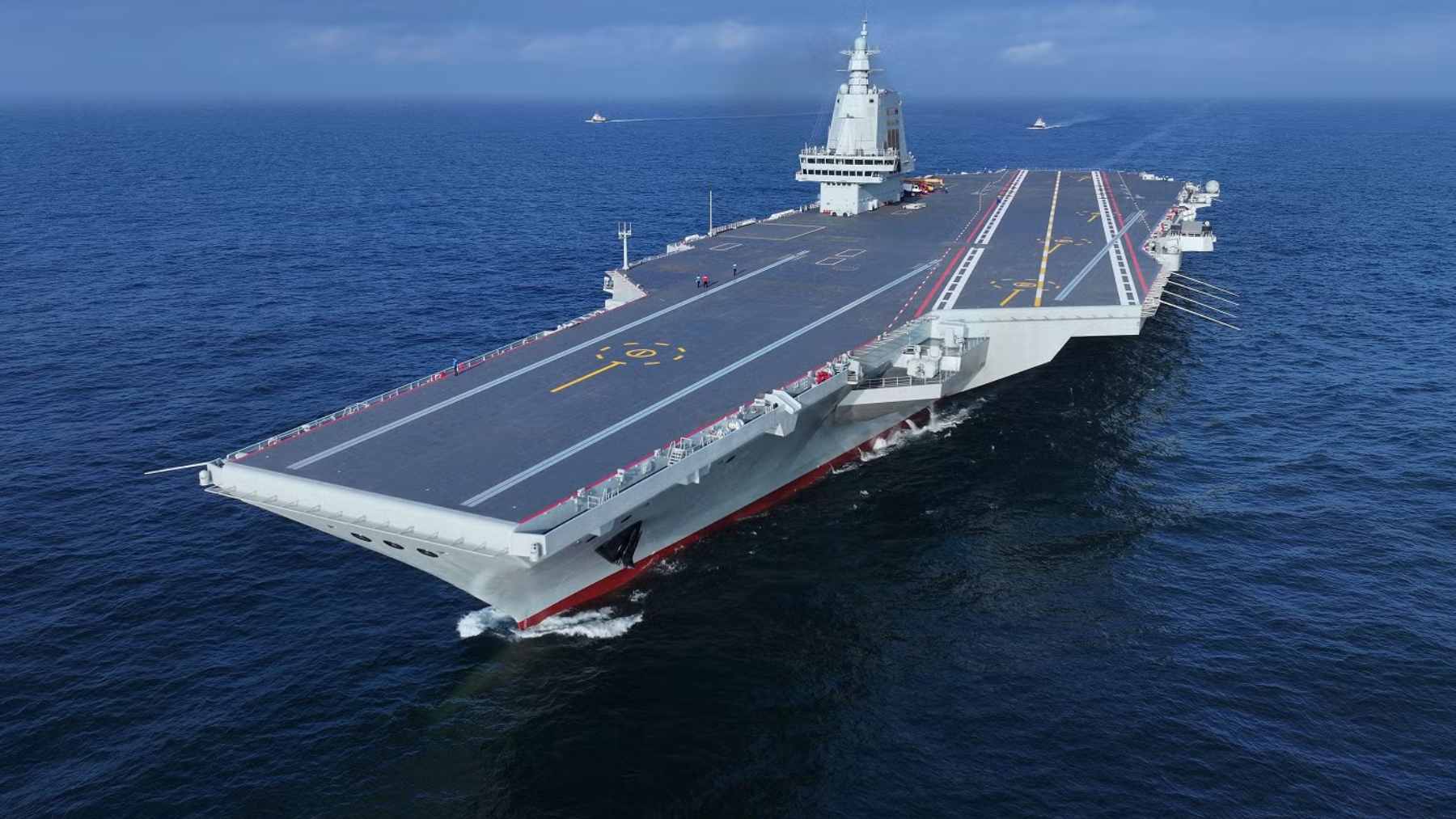
China has officially taken its most advanced aircraft carrier, the Fujian, into service at a naval port in Sanya, turning a long-watched ship into a real asset for China. At first glance, the new carrier looks like a pure advantage for Beijing.
Yet in the narrow waters between China and Taiwan, that advantage becomes far less clear.
Chinese state media have already hinted that the Fujian will eventually sail through the Taiwan Strait as a show of strength. In Taiwanese reports, naval officers reacted with open skepticism and even some dark humor.
They argued that once the Fujian enters the Strait it would sit inside the range of more than one hundred land-based anti-ship missiles and could effectively become a training target instead of a fearsome flagship.
For people far from the region, all of this can sound distant from daily worries like rent or the electric bill. Yet what happens around the Strait shapes global shipping, chip supplies, and overall stability in the Indo Pacific.
A floating symbol of China’s blue water ambitions
The Fujian is China’s third aircraft carrier and its first built entirely at home with a flat deck and electromagnetic catapults that work in a similar way to the system on the latest American Ford class carriers.
These catapults let the ship launch heavier aircraft carrying more fuel and weapons, including new J 35 stealth fighters and KJ 600 early warning planes that were shown on the deck during its commissioning ceremony.
At the November 2025 event, President Xi Jinping boarded the ship, presented the flag of the People’s Liberation Army Navy, and inspected its electromagnetic launch system. Official reports describe the Fujian as a key step toward a “world class” navy that can operate far from China’s shores.
Analysts agree that, at least on paper, it is a big leap in capability compared with the older Liaoning and Shandong carriers.
The catch is that new technology takes time. Defense experts estimate that the Fujian still needs extensive testing, aircraft integration, and training before it can fight as a fully-formed carrier strike group. At the end of the day, it is still more of a symbol than a finished weapon.
Why the Taiwan Strait is hostile water for carriers
Taiwanese officers point out something basic. Carriers are designed to thrive in the open ocean. The Taiwan Strait is relatively narrow, from roughly 410 kilometers at its widest to about 130 kilometers at its narrowest.
That means a large ship has fewer places to maneuver, fewer directions to retreat, and far less room to hide.
Imagine trying to park a huge cruise ship in a crowded marina while every pier has someone aiming a fire hose at you. That is roughly how Taiwanese planners frame the Fujian’s situation inside the Strait.
Taiwan has built a dense network of fixed and mobile launch sites for its Hsiung Feng series of anti-ship missiles along the island’s west coast and on offshore islands such as Penghu and Dongyin. In simple terms, any large vessel sailing into the Strait would quickly enter overlapping kill zones from several directions at once.
Taiwan’s missile wall and area denial strategy
The backbone of that wall is the Hai Feng shore based anti-ship missile group, a formation that has been testing new extended range Hsiung Feng III missiles in recent exercises.
Public data give a rough sense of the threat. The Hsiung Feng II, a subsonic sea-skimming missile, has a standard range of about 148 kilometers, with upgraded versions reaching between 160 and 200 kilometers and electronic countermeasures broadly comparable to Western designs.
The Hsiung Feng III adds a supersonic terminal attack profile with ranges in the 150 to 250 kilometer band, and Taiwanese sources regularly describe it as a “carrier killer.”
On top of that, an extended range HF III variant, often labeled HF IIIER, is estimated to reach roughly 400 kilometers. In practical terms, that means Taiwan can hold surface ships at risk well beyond the midline of the Strait and even close to the Chinese coast, especially when mobile launchers disperse along highways and in camouflaged sites.
For the most part, this is classic area denial strategy. Rather than trying to match China ship for ship, Taiwan invests in relatively cheaper missiles that can threaten high-value targets like carriers from land.
Experts warn that any large Chinese vessel entering this environment would face “a very saturated missile picture” if conflict ever broke out.
What it means for everyone watching
So does the Fujian change the balance over Taiwan? To a large extent, not yet. The carrier matters more as a signal of China’s long-term ambition to operate far into the Pacific than as an immediate trump card inside the Strait, where geography and Taiwan’s missile network still strongly favor the defender.
At the same time, big ships sailing through tight waters raise the risk of miscalculation. A future transit of the Fujian near Taiwan would likely trigger mirrored shows of force, with fighter sorties, missile deployments, and plenty of anxious watching by neighbors and markets.
That is why regional planners keep stressing crisis communication and clear red lines, even while both sides upgrade hardware.
For readers following from afar, it helps to think of the Fujian and Taiwan’s missile wall as two parts of the same story. One side is betting on large, impressive symbols of national power. The other is betting on many smaller systems designed to make those symbols think twice before coming too close.
The official statement was published on english.gov.cn.