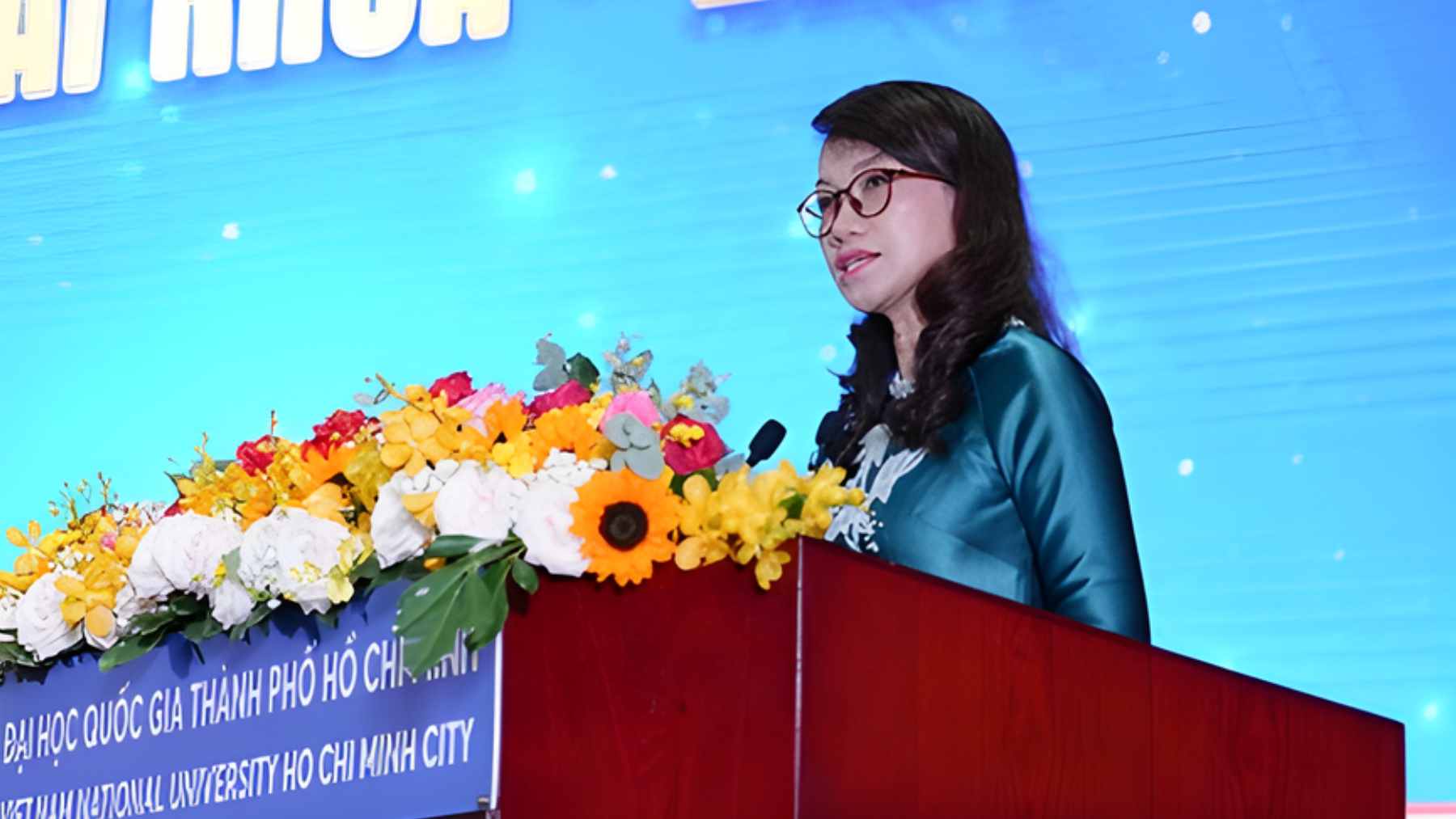
At a packed opening ceremony at Vietnam National University, Ho Chi Minh City,Professor Dr Nguyen Thi Thanh Mai stepped up to the podium and offered students and faculty three short instructions. They should, she said, dare to think differently, dare to fail, and dare to try again.
Within days, clips of that speech were circulating across Vietnamese social media, turning an academic ceremony into a national conversation about how a country that wants more science and innovation handles mistakes.
The message came during the university’s 2025 opening ceremony, held in late October in Ho Chi Minh City. The event carried a clear theme, translated as “Aspiratcion for innovation and creativity for a strong Vietnam,” and brought together senior leaders, scientists, and hundreds of new and returning students.
In that setting, Mai’s three-part motto landed as something more than a motivational slogan. It sounded closer to a roadmap for how one of Vietnam’s largest research systems hopes to grow.
Three short words for a long scientific journey
In her address, Mai urged students not to stay mentally confined within their own department or classroom. She encouraged them to learn from professors, friends, outside experts, and even everyday citizens, reminding them that meeting a Nobel laureate or joining an international science project is not out of reach for students at this university.
The hard part, she suggested, comes afterward. Achievements on paper are one thing. Turning personal talent into real social impact is much tougher without a culture that rewards curiosity, risk taking, and creative thinking.
Every challenge becomes a lesson, and in her words the most valuable lessons are often the ones that come from failure. Instead of treating setbacks as personal disasters, she asked the audience to accept them, stand up quickly, and try again as a better version of themselves.
For scientists and staff, the bar was even higher. Mai called on faculty members to act as role models who also experience failure, sometimes more painfully than their students.
Yet that, she argued, is exactly when teachers need to show how to move forward, by experimenting with new research topics that serve social needs and by rethinking how they teach and manage their labs and offices.
Why the message resonated on campus
Many students heard something they do not usually get from authority figures. One chemistry major said she was especially struck by the focus on “daring to fail,” noting that many young people hesitate to try new things because they fear being judged if they make mistakes.
In her view, if you never start, you never find out how far you can really go.
Another student from social sciences described feeling newly motivated to think boldly, act on her ideas, and pursue her passion with more energy after listening to what she called a heartfelt speech.
Staff working in student affairs said the three-part message felt like permission to treat every setback as a serious learning opportunity, not only for undergraduates but also for the employees who support them.
One specialist pointed out that using failure well requires careful preparation and responsible follow through, so that each misstep builds stronger character rather than discouraging people.
A staff member in the central office heard the speech as a reminder to constantly update processes and mindsets, keeping students at the center while the university pushes toward its development goals.
Parents were listening too. One mother admitted she felt particularly moved by the phrase “dare to fail.” She recognized herself in the many parents who want safe, stable paths for their children and who sometimes protect them so much that they have no chance to try, stumble, and grow.
Failure, science, and Vietnam’s innovation push
Mai’s words come at a time when Vietnam is asking more of its universities. A recent national resolution identifies higher education as a core engine for high-level human resources, science, technology, and innovation.
VNU HCM itself serves tens of thousands of students across seven member universities and has publicly stated ambitions to become a leading Asian hub where science, technology, and Vietnamese culture meet.
In parallel, university leaders have spoken about using newly-relaxed regulations to move faster. Mai has argued that legal barriers are now less restrictive and that if professors do not step forward first, students cannot be expected to lead.
She connects the “dare to fail” mindset directly to the institution’s goal of joining the top tier of Asian universities, suggesting that only people who accept risk and recovery can truly accelerate research and innovation.
Put in practical terms, this could mean more freedom to test new teaching methods, run early-stage experiments, or launch social projects that may not work perfectly the first time. It could also mean acknowledging the emotional weight of failure in a high pressure academic environment and building support systems that help both students and faculty bounce back.
From viral quote to everyday practice
For now, the speech lives online as a short clip and a catchy three-part line that people share in group chats and news feeds. The real test will come in classrooms, labs, and offices over the next few years.
Will students feel safe proposing wild ideas in a robotics club or climate lab, even if the first version fails badly? Will faculty feel backed when they redesign a course around project-based learning that might be messy at the beginning?
Mai’s speech does not solve those challenges on its own. What it does, to a large extent, is name a shift that many educators and researchers believe is necessary if Vietnam wants to grow its scientific and technological capacity.
Turning failure into fuel is not just a Silicon Valley slogan anymore. It is now part of the official language at one of the country’s flagship universities.
The press release was published by the Vietnam National University Ho Chi Minh City.