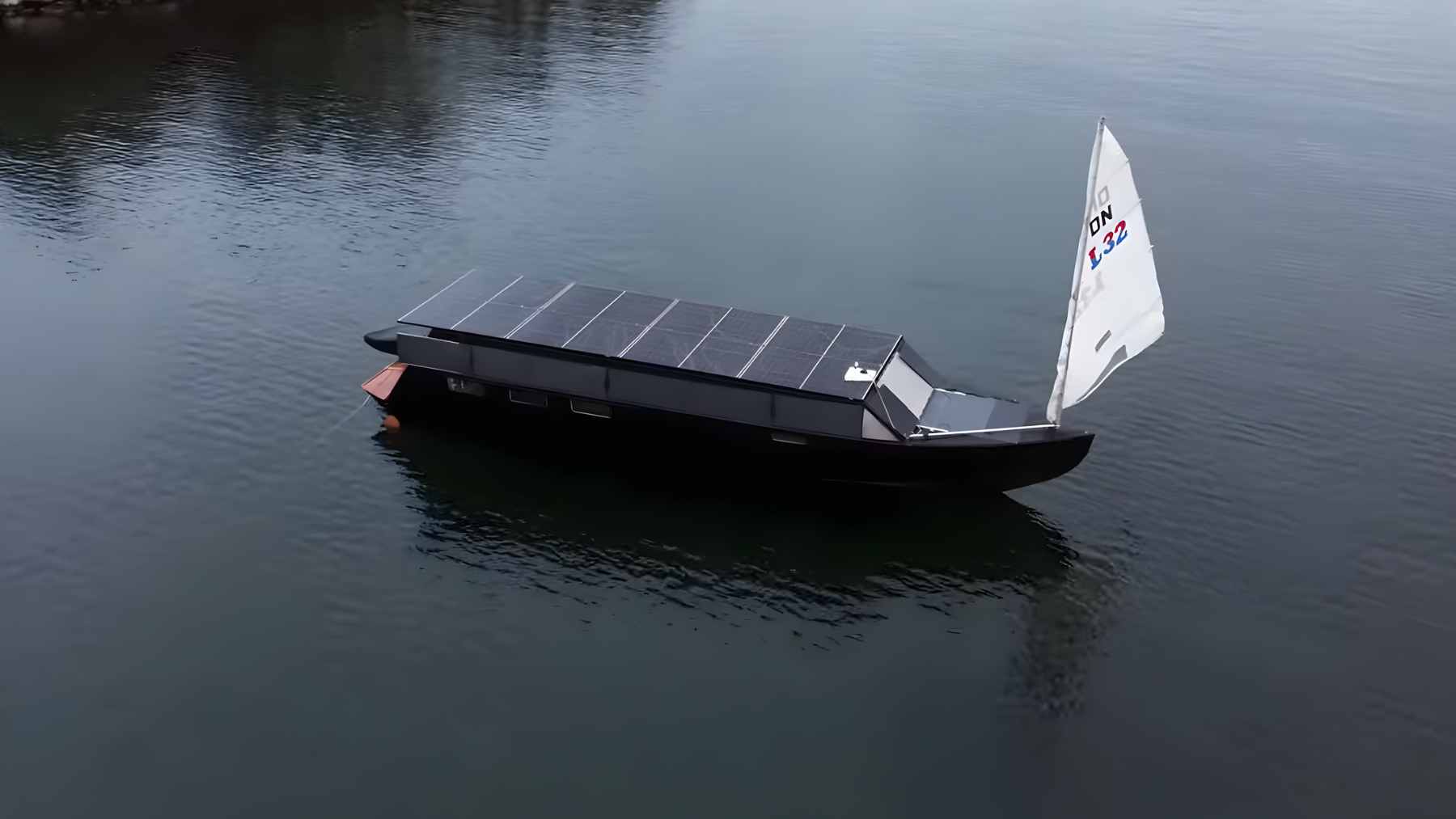
A Finnish adventure YouTuber named Lukas has spent around 200 days turning his dream of an “infinite range” boat into reality with Helios 11, a slim, solar-powered explorer yacht built in Finland and now testing the frozen canals of France.
His handmade vessel aims to cruise long distances without fuel stops, shore power, or noisy generators, relying instead on the sun and a carefully engineered hull. It is a bold promise, and winter has already put it to the test.
True North Yachts builder explains solar panels, batteries, and electric propulsion
On his channel True North Yachts, Lukas shows how he built the roughly 35 foot long yacht with a very narrow waterline width of about 2.2 meters, stripping away weight and complexity so the boat needs as little power as possible to keep moving.
Instead of a big diesel engine, the yacht carries marine grade solar panels that feed a lithium battery bank and an electric motor along with the usual house loads for navigation, lighting, and life on board.
How solar powered yachts work and why “infinite range” is tricky
Solar power on boats is not new, but Helios 11 pushes the idea further than most cruising projects. Typical yacht panels sit in the mid-teens to a bit above twenty percent efficiency, and deck space limits how many modules you can bolt down.
That is why many electric boat builders describe solar as one part of a wider energy plan that also leans on shore charging or backup generators. Lukas flips the problem around by designing the boat so it sips as little energy as possible.
Frozen French canals force a real-world stress test for a solar yacht
Then came the ice. After sailing south from Finland, he guided Helios 11 into French canals only to find sections crusted over with winter freeze that locked the boat in place. For most cruisers, that would simply mean an unscheduled break and a bigger grocery bill at the nearest marina.
He treated it differently. Stuck in place, he used the pause to pressure test his ideas and to build a scale model of Halo 13, an ultra-narrow catamaran concept he believes could be even more stable and efficient.
Halo 13 ultra-narrow catamaran stability tests aim to prevent capsizing
Working at one-thirteenth scale, he built two slender hulls, tuned the ballast to match a realistic center of gravity, and sent the model into choppy water from different angles. Side waves, head on waves, diagonal chop, the catamaran stayed surprisingly flat.
Lukas says only an extreme breaking wave from the wrong direction would likely flip the design, a level of stability that could matter as much as range on a future ocean going solar yacht.
What this means for low-carbon boating and electric boats
The experiment highlights what solar yachts can and cannot do in the real world. When days are long and skies are clear, solar-powered boats can glide along with almost no running costs, no diesel fumes, and a soundtrack of gently lapping water instead of engine drone. In shoulder seasons and high latitudes, energy budgets tighten.
Shorter days, low sun angles, and more cloud cover mean the panels gather less energy, so skippers either slow down, accept more time at anchor, or plan for some backup charging.
Clean energy shift reaches transportation, from electric cars to solar yachts
Projects like Helios 11 are showing what happens when boating meets the same clean energy shift already reshaping city streets and even backyard tools.
Cities are starting to phase out small gas engines in favor of quieter electric models, whileclimate scientists and policy makers debate how quickly we need to cut combustion in cars, trucks, and ships. The core question is familiar.
How much energy do we really need, and how much of that can come from sources that do not heat the planet further.
Life aboard a DIY solar-powered yacht and the appeal of off-grid travel
There is also a social side to stories like this. Lukas shares his wins and setbacks openly, so viewers see both the charm and the compromises of life on an experimental solar yacht.
For someone watching from a city apartment, wrestling with an electric bill and climate headlines, the idea of drifting along a canal with nothing but sunlight in the batteries can feel like more than a clever engineering trick, almost a small preview of what low-carbon living might look like on the water.
The main project video was published on True North Yachts.