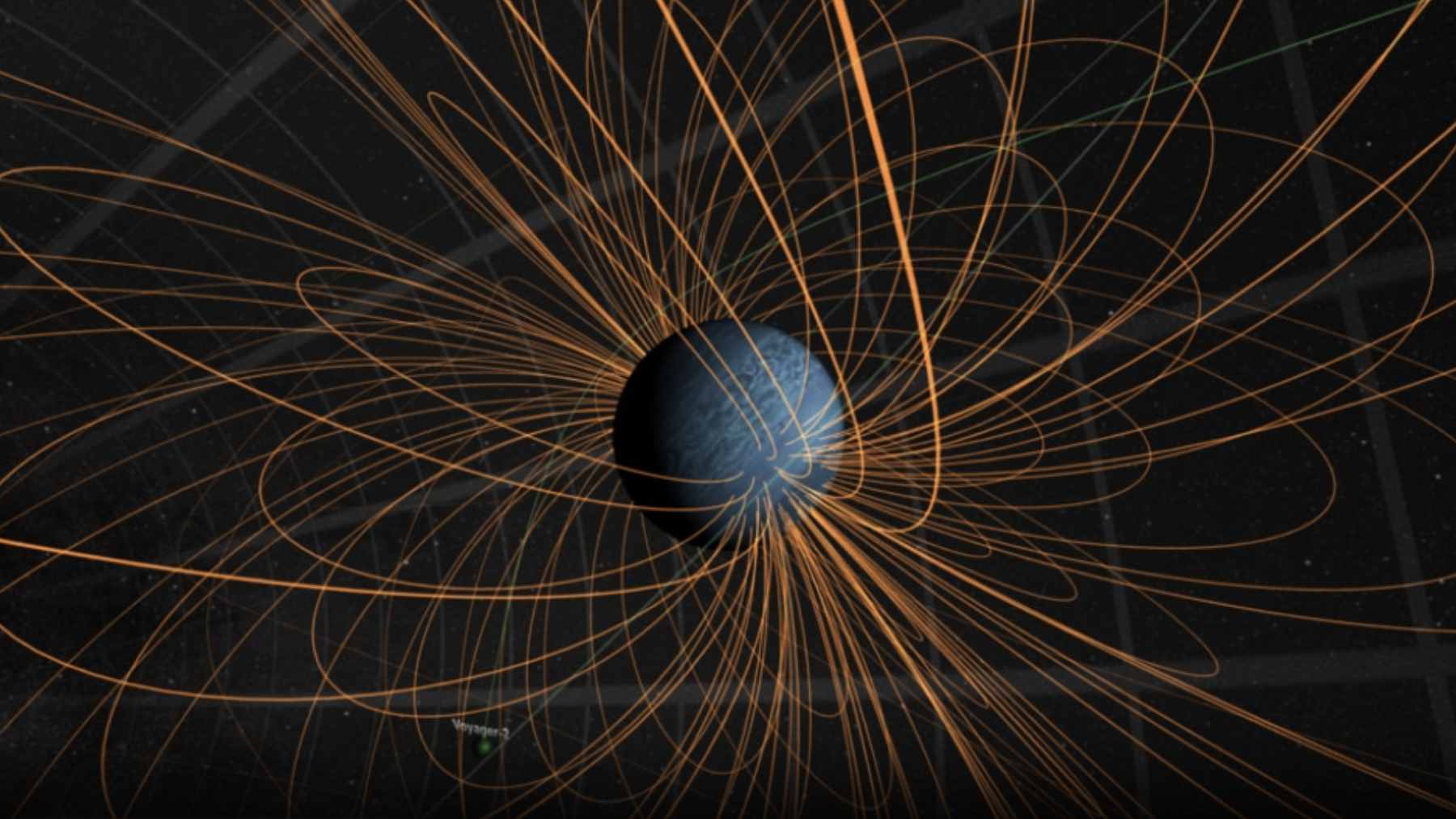
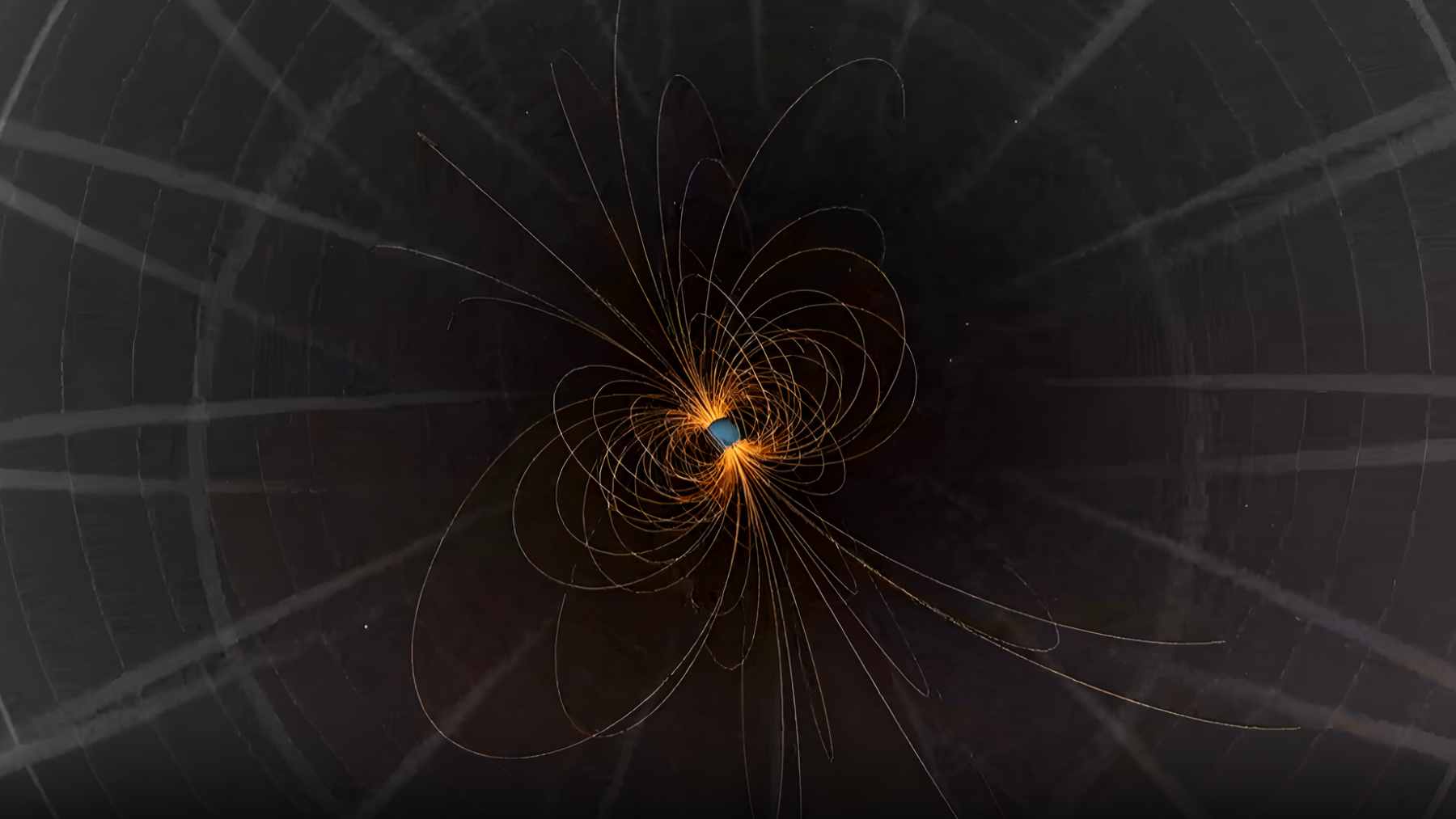
Back in August 1989, when Voyager 2 skimmed just a few thousand miles above Neptune, its instruments picked up something that did not match the neat textbook picture of a planetary magnetic field. The field looked tilted, lopsided, and cluttered with extra poles.
For decades, those strange readings sat in archives as a half-solved mystery.
Neptune’s magnetic field is tilted about 47 degrees relative to the planet’s rotation and its source region appears to be shifted by more than half a planetary radius away from the center, unlike the mostly centered fields of Earth or Jupiter. Voyager 2 remains the only spacecraft to have flown past the ice giant up close, so those few hours of data still carry a lot of weight.
Now, new experiments with an exotic phase of water are giving scientists a better way to read that old magnetic fingerprint.
A strange kind of water deep inside the ice giants
An international team has pushed ordinary water to pressures more than one and a half million times higher than the air at sea level and to temperatures of roughly 2,500 Kelvin. Under those conditions, similar to those inside Uranus and Neptune, water enters a state called superionic water.
In this phase, oxygen atoms form a solid lattice while hydrogen ions move freely through the structure and carry electric current.
Superionic water has been predicted for decades and first recreated in laboratory experiments a few years ago. It is a leading candidate for the material that powers the unusual magnetic fields of the ice giants, since vast reservoirs of high-pressure water are expected deep inside those planets.
Making hot black ice in the lab
To probe this material in detail, the researchers used high-energy lasers and ultrafast X-rays at facilities including SLAC National Accelerator Laboratory and European XFEL. Tiny samples of water were sandwiched between diamond plates.
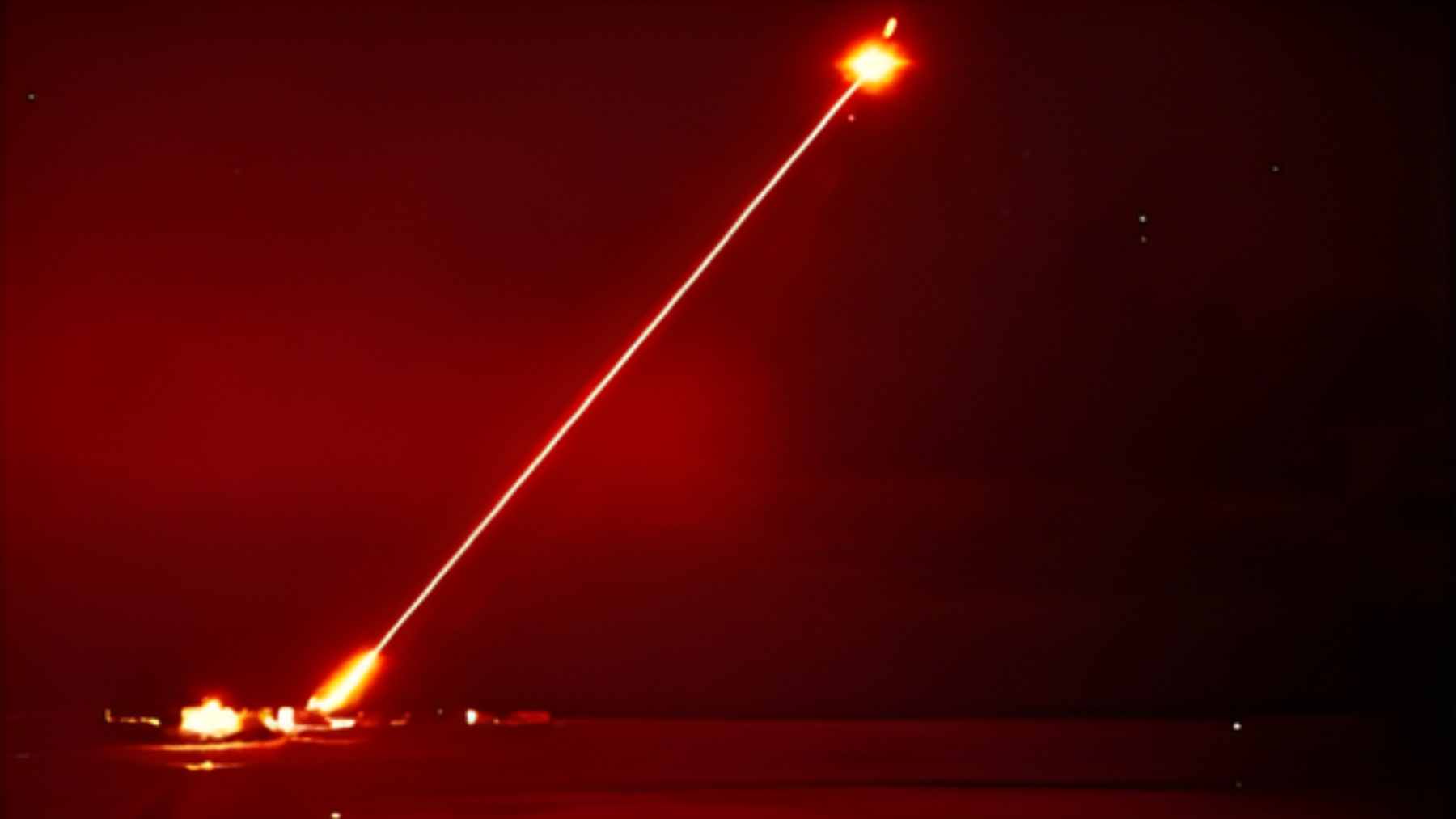
Laser-driven shock waves then squeezed and heated the water for just trillionths of a second while powerful X-ray pulses recorded how the oxygen atoms were arranged.
The team expected to see one clean crystal structure in the oxygen lattice. Instead, the diffraction patterns revealed overlapping face-centered cubic and hexagonal close-packed layers, with misalignments and defects woven throughout the sample.
Physicist Nick Hartley summed up the surprise, saying that “we were looking for crisp, clear lines, and instead we found blurry boundaries.”
Why messy ice fits Voyager 2’s weird magnetic map
In planetary terms, that messy structure matters. The rigid oxygen framework and fast moving hydrogen ions make superionic water an excellent electrical conductor. The exact shape of the lattice determines how easily those ions can flow in different directions.
If the lattice is riddled with defects and mixed stackings rather than neatly ordered, the electrical currents that generate a planet’s magnetic field will also be irregular. That kind of geometry naturally favors a tilted, multipolar field like the one Voyager 2 measured at Neptune, where the effective magnetic dipole is offset by about 0.55 planetary radii.
Senior scientist Arianna Gleason noted that “the unique structure of superionic water likely gives rise to its conductive properties and influences magnetic fields on the planetary scale,” highlighting why mapping that structure is so important.
Earlier work had already shown that superionic ice exists and hinted that it could explain the odd magnetism of Uranus and Neptune, but many models assumed a single tidy crystal pattern. The new results point toward a more complex interior, where different packings coexist and blend.
That gives planetary scientists a more realistic set of numbers to feed into computer simulations of magnetic dynamos inside the ice giants.
From fleeting flashes to planetary portraits
The experiments only hold water in the superionic state for tiny fractions of a second before everything tears apart, yet those fleeting flashes are enough to measure the pressures, temperatures, and structures that matter for planetary interiors.
Next, the team plans to measure electrical conductivity more directly and to explore mixtures of water with other likely planetary ingredients such as ammonia and methane.
Combined with future missions that many scientists hope will revisit the ice giants, these measurements could turn Voyager 2’s single flyby into a much sharper picture of what is happening thousands of miles below Neptune’s clouds.
One more twist. Because planets similar to Uranus and Neptune appear to be common around other stars, this hot, dark, electrically active form of ice may actually be the most common form of water in the universe rather than the liquid in our oceans.
For now, the key message is that Voyager 2’s weird magnetic measurements finally have a plausible physical match in the lab. That makes superionic water a central player in the story of how ice giant worlds evolve and how their invisible interiors shape the space around them.
The study was published in Nature Communications.