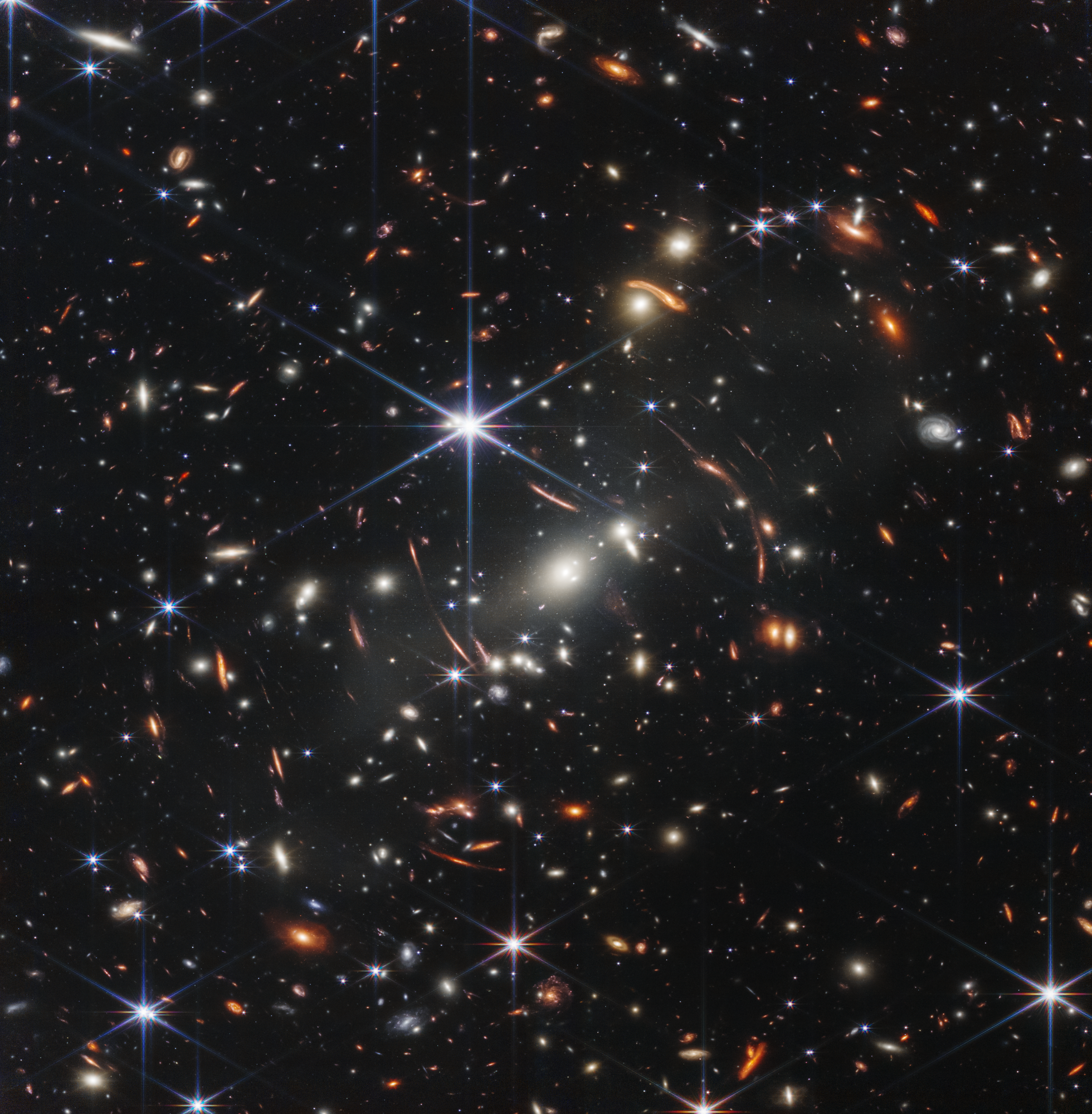
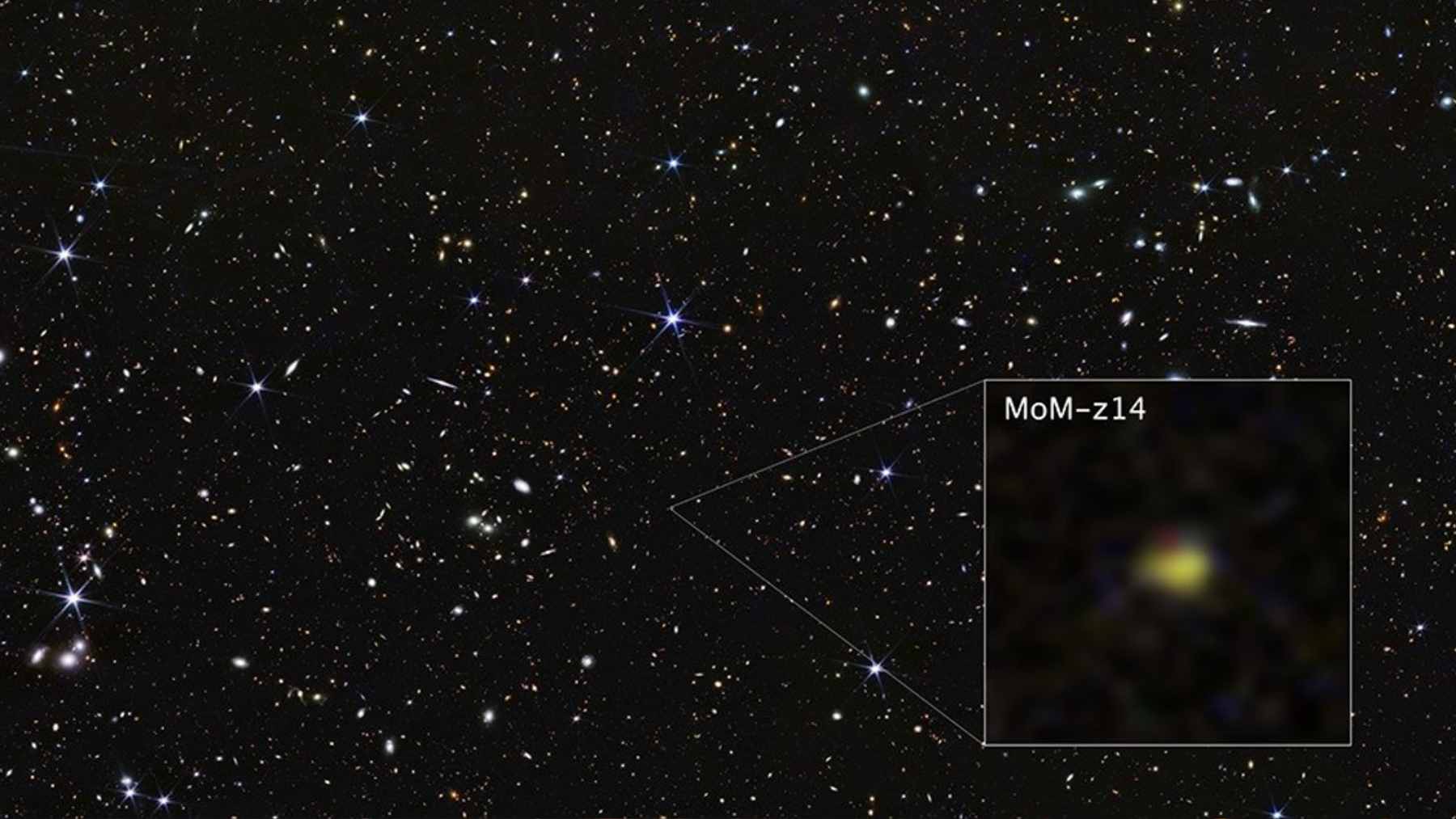
A tiny, yellow smudge in a James Webb deep image has just pushed our view of the universe farther back in time than ever before. The galaxy, nicknamed MoM-z14, shone only about 280 million years after the Big Bang, and its light has been traveling for roughly 13.5 billion years before finally hitting Webb’s infrared instruments.
Astronomers now say it is the most distant spectroscopically-confirmed galaxy known, beating the previous James Webb record.
The discovery, led by astrophysicist Rohan Naidu at the Kavli Institute for Astrophysics and Space Research at Massachusetts Institute of Technology, has been peer reviewed and published in The Open Journal of Astrophysics after first appearing as a preprint in 2025.
In a statement shared by NASA, Naidu said that “with Webb, we are able to see farther than humans ever have before,” and added that what they are finding does not match long-standing theoretical expectations.
A record that stretches the cosmic map
So how do we know this distant smudge really comes from the universe’s childhood and not from some closer, faint object in the background of your night sky?
Astronomers rely on redshift, a measure of how much the expansion of space has stretched a galaxy’s light to redder wavelengths during its journey. For MoM-z14, Webb’s NIRSpec instrument measured a cosmological redshift of 14.44.
In simple terms, the light has been stretched more than fourteen times on its way here, placing the galaxy only a few hundred million years after the universe began.
Crucially, this distance is not just an educated guess from images. The team used spectroscopy to split the galaxy’s light into its component colors and picked out a sharp Lyman break along with several ultraviolet emission lines. That combination locks down the redshift and makes MoM-z14, in the authors’ words, the most distant spectroscopically-confirmed source to date.
Small, bright and strangely rich in heavy elements
On paper, MoM-z14 should be a lightweight. It spans only about 240 light years across, which makes it roughly four hundred times smaller than the Milky Way. Yet it shines with a brightness comparable to the dwarf companion known as the Small Magellanic Cloud and seems to pack a similar amount of mass.
Webb caught the galaxy during an intense growth spurt, a burst of rapid star formation that would put many mature galaxies to shame. Even more puzzling, its gas shows unusually high levels of nitrogen compared with carbon.
That pattern looks a lot like the chemistry seen in ancient globular clusters around our own galaxy and in some of the oldest stars in the Milky Way.
At the end of the day, that means this baby galaxy already carries the fingerprints of earlier generations of massive stars, even though, in theory, there has barely been time for such enrichment to happen.
A growing gap between theory and observation
Before James Webb launched, most models suggested that bright, hefty galaxies should be rare in the first 500 million years of cosmic history. MoM-z14 tells a different story. The new study estimates that galaxies this luminous at redshift around 14 appear hundreds of times more often than standard pre-Webb simulations predicted.
Scientists now talk openly about a widening gap between textbook pictures of the early universe and what Webb is actually seeing.
For the most part, theory expected tiny, dim building blocks at that time. Instead, Webb keeps turning up compact, chemically-enriched overachievers that already look surprisingly “grown up” against the backdrop of cosmic dawn.
If you are wondering why that matters for life on Earth and not just for cosmologists, think of it as the origin story of everything in your daily world. The timing and efficiency of those first bursts of star formation set the stage for later generations of stars, planets and eventually the heavy elements in your phone, your car and even your body.
A window into the first star clusters
The unusual nitrogen enrichment in MoM-z14 hints that it may host extremely massive stars in dense clusters, possibly similar to hypothetical “supermassive stars” that some researchers think helped seed today’s globular clusters.
The paper argues that we may be watching that process in real time, only a few hundred million years after the universe switched on.
If that connection holds up, this tiny galaxy could become a kind of Rosetta stone linking Webb’s distant record breakers to the ancient star clusters that circle our own galaxy and quietly decorate backyard telescopic views on clear nights.
What comes next
MoM-z14 is part of a larger Webb program nicknamed “Mirage or Miracle” that hunts for unexpectedly bright galaxies in deep survey fields. The team and their colleagues expect many more candidates in the coming years, and future missions such as the Nancy Grace Roman Space Telescope should help count these early galaxies by the thousands.
For people scrolling past yet another spectacular Webb image on their phones, it can be easy to forget what is at stake. To a large extent, discoveries like MoM-z14 are forcing scientists to redraw the first chapters in the story of how structure formed in the universe.
The study was published in The Open Journal of Astrophysics.