
If you are wondering where life might feel a little easier in 2026, one fresh ranking points to a familiar pattern with a surprising twist. According to the latest Quality of Life Index by country, the top spots are held by small, wealthy European nations, while Oman quietly slips into fourth place worldwide.
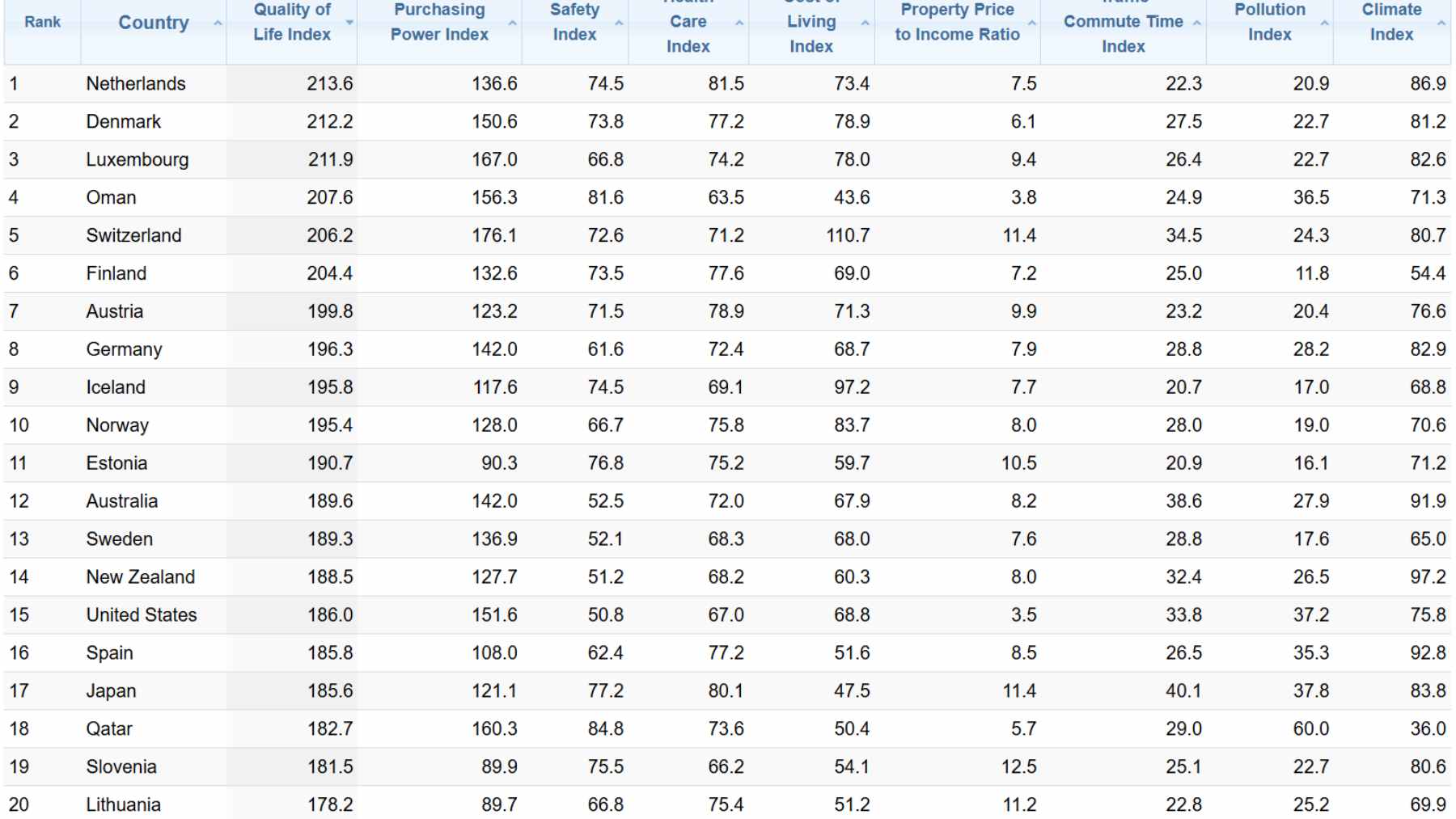
Numbeo’s 2026 table puts Netherlands first, followed by Denmark and Luxembourg. Oman takes fourth, ahead of Switzerland, with Finland, Austria, Germany, Iceland and Norway rounding out the top ten.
For anyone thinking about a move, that ranking suggests something simple. If you care about safe streets, decent health care, and an electric bill that does not swallow your paycheck, these are the countries that currently score best on that mix.
What the Quality of Life Index actually measures
The Quality of Life Index is built by Numbeo, a crowd-sourced database that compiles millions of user submitted prices and ratings for cities around the world.
For each country, Numbeo combines eight sub indexes. These look at local purchasing power, safety, health care, cost of living, property price to income ratio, traffic commute times, pollution and climate.
In practical terms, that means the ranking is not only about how big an average salary looks on paper. It also reflects how far that money goes once you pay rent, sit in traffic, visit a doctor and breathe the local air.
Mid-year data from 2025 already hinted at this balance. Luxembourg topped that list with the Netherlands, Denmark and Oman clustered just behind and still ahead of Switzerland, thanks in part to more favorable cost of living and housing scores.
Why Oman stands out in a European heavy top ten
So how does a Gulf state end up shoulder to shoulder with long-established European welfare states?
Numbeo’s 2026 figures suggest Oman has a powerful combination of high perceived safety, respectable health care and relatively low everyday costs. Its cost of living index is less than half that of Switzerland, while its property price to income ratio is roughly a third, which helps residents feel their paychecks stretch further when it comes to rent or buying a home.
On top of its global fourth place, Oman ranks first across Asia and the Middle East in the mid-year 2025 report, reinforcing its regional outlier status.
Add in investments in infrastructure and health services, plus natural scenery that draws tourists as well as new residents, and the picture becomes clearer. For many people, daily life there may mean shorter commutes, lower housing pressure and a calmer sense of security, even if average salaries are lower than in western Europe.
How much weight should you give these rankings
There is an important note of caution. Numbeo’s data is largely user generated and some of its indices, especially on crime and safety, have been criticized by researchers for sampling bias and for reflecting perception more than hard official statistics.
So this ranking should be treated as a snapshot rather than a final verdict. It can help someone compare options if they are deciding between, say, Amsterdam and Muscat, but it cannot tell you how you will feel about the local language, culture or winter darkness.
At the end of the day, the Quality of Life Index is a useful compass, not a detailed road map. It points to countries where, on average, people report that pay, prices, safety and services line up in their favor.
The study was published on Numbeo.