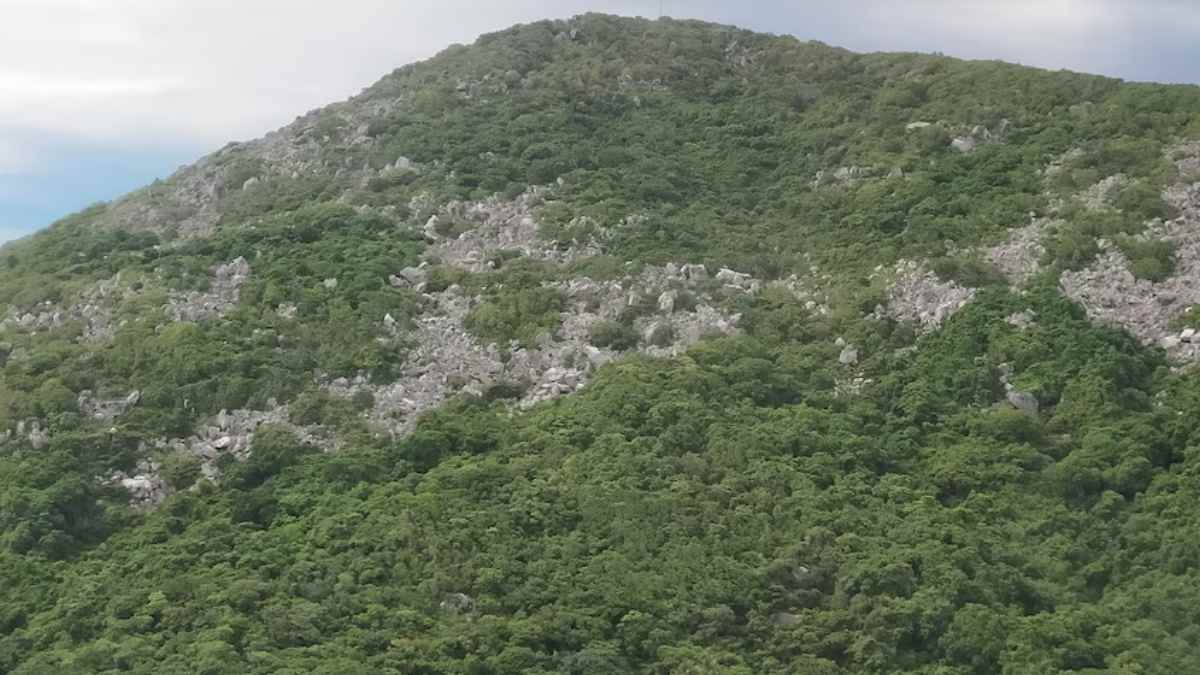
Three animals found nowhere else on Earth have been identified on Dauan Island in Australia’s Torres Strait. The new roster includes two frogs and a gecko, all tucked into boulder fields on a tiny, remote island near Papua New Guinea.
Researchers from James Cook University (JCU) made the find during targeted night surveys after rain. The discovery helps fill a quiet gap on Australia’s species map and hints that more hidden life could be waiting in the rocks.
A tiny island with big surprises
The two frogs are restricted to deep piles of granite boulders and do not occur on neighboring islands. Biologists classify them as endemic, limited to one spot and found nowhere else.
One is a small climbing species, Choerophryne koeypad, with oversized toe pads and a high, tink-like call. The other, Callulops gobakula, is larger and croaks from cracks between boulders.
The survey was led by Associate Professor Conrad Hoskin. His team focused on wet nights, when hidden frogs are most active.
How the discovery happened
“There were these two different frog calls that I could hear up there that were clearly something I didn’t know,” said Hoskin. It was the moment he realized the island might hold species completely unknown to science, hidden among its rain-slick granite slopes and ancient boulders.
Koeypad and gobakula are part of the microhylid, a family of mostly tiny frogs that often skip the tadpole stage. Instead, the young hatch straight from eggs as fully formed froglets.
Names that carry the island
Local language and landscape shaped the names. The tiny climber, Choerophryne koeypad, takes its name from a phrase for rocky mountain, a nod to Dauan’s steep granite.
The larger Callulops gobakula reflects the rugged boulder maze it calls home. Each name roots the discovery in Dauan’s landscape, turning scientific labels into stories of place and persistence.
A gecko with a striped signature
The Dauan Island gecko, Nactus simakal, shows a banded pattern and long, slender legs. It was described after genetic and anatomical work. This gecko also lives in boulder stacks and is likely confined to Dauan. The tight range makes every patch of rock matter.
Researchers found that its closest relatives live far to the north in New Guinea, underscoring how long the Dauan population has been isolated. Subtle differences in its scales, proportions, and coloration confirmed that it was not just a variation, but a distinct species.
Its name, Simakal, honors the mountain that defines the island’s skyline, linking the animal’s identity to the granite slopes that have sheltered it for millennia.
What the frogs tell us about history
The frogs sit far south of their nearest kin. The closest Callulops is roughly 124 miles to the north, and the nearest Choerophryne records are about 174 miles away.
Authors propose a simple story. Past drying shrank rainforests, but deep boulder fields created climatic buffering, natural shelter that keeps heat and moisture swings milder.
Why these species persist here
Dauan lies between Australia and New Guinea, a region once linked by a land bridge. That bridge let animals move, then isolation drove them apart.
Cool, shaded crevices kept conditions livable during harsh spells. Species that needed damp cover hung on in the rocks while lowland forests thinned.
Why protection now matters
Torres Strait has strict biosecurity, rules that stop pests and diseases spreading between places, under national law and permits for high risk goods. The federal department outlines these requirements in detail on its official page.
Even so, new threats slip through. In September, rangers captured a live cane toad on Saibai Island, marking the first record for that outer island.
Island biodiversity is fragile. The Bramble Cay melomys vanished from a low sand cay in recent years, with the official Queensland Government documenting the failed searches and attributing the loss to repeated storm surge inundation.
What scientists will watch next
The range size is tiny for these Dauan species. The frog paper notes they meet a narrow range Vulnerable category used by the International Union for Conservation of Nature. Mapping exact population pockets on the island is now a priority.
Keeping invasives out may be the make or break step. Each boulder field is a refuge that cannot be easily rebuilt if damaged.
The study is published in Zootaxa.