The Moon may be richer in carbon than once thought. A team analyzing dust returned by China’s Chang’e‑5 mission has found natural few‑layer graphene inside a tiny grain of lunar soil, verified with multiple high‑resolution imaging and spectroscopy techniques. The study was published on June 17, 2024, and the authors say it is the first clear confirmation of this ultra‑thin carbon material in lunar samples.
Lead author Wei Zhang of Jilin University and collaborators, including Wencai Ren at the Chinese Academy of Sciences’ Institute of Metal Research, examined an olive‑shaped speck about 2.9 by 1.6 millimeters collected in 2020. According to the researchers, the graphene occurs in flakes only a few atomic layers thick and appears to have formed naturally in the lunar environment.
What the team studied
The Chang’e‑5 spacecraft brought 1.73 kilograms of material back to Earth on December 17, 2020, from a young lava plain in Oceanus Procellarum on the Moon’s nearside. Those rocks and soils are the youngest mare basalts ever collected, erupting roughly two billion years ago, which makes them especially valuable for learning how late lunar volcanism worked.
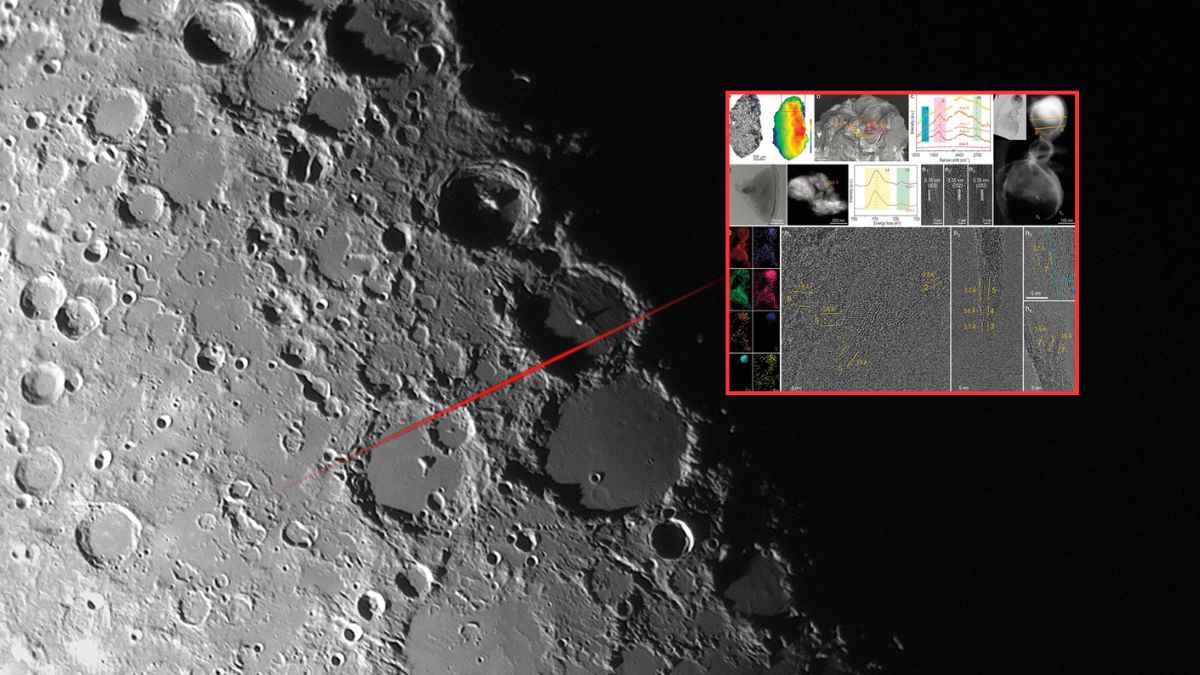
To search for carbon, the researchers used a suite of tools that can “see” structures far smaller than a human hair. These included a laser‑based method called Raman spectroscopy, electron microscopes that image atoms, and elemental mapping
that shows where different chemical elements concentrate. Together, these methods can distinguish ordered carbon like graphite or graphene from more disordered, sooty carbon.
What they found inside the grain
Inside the sample, the team identified flakes of few‑layer graphene, ranging from two to seven layers, and thin carbon shells wrapping tiny mineral particles. The flakes showed the telltale signatures of well‑organized carbon, while the shells revealed slightly more disorder, both consistent with natural formation rather than laboratory contamination. The graphene sat next to minerals containing iron, which the team links to how it formed.
Per their report, the graphene‑rich zones were closely associated with an iron compound, a finding confirmed by cross‑checking multiple techniques on the very same microscopic spots. This combination of structure, context, and methods is what convinced the authors they were seeing naturally formed few‑layer graphene on the Moon.
What is graphene, in simple terms
Graphene is a sheet of carbon atoms arranged like chicken wire, only one atom thick. Stack a few of these sheets together and you get “few‑layer graphene,” which still keeps many of graphene’s special properties.
Those properties include exceptional strength, electrical conductivity, and heat conduction. The discovery of its natural formation on the Moon is significant because it demonstrates that these complex carbon structures can self-assemble in harsh space environments.
How could Moon graphene form
The authors propose a high‑temperature pathway driven by the Moon’s own processes. Ancient volcanic activity would have heated iron‑bearing minerals at the surface, while the constant solar wind supplied carbon‑bearing gases and helped stir the soil. Together, these conditions could have re‑arranged carbon atoms into graphitic forms, producing few‑layer graphene flakes and thin carbon shells on mineral surfaces.
They also note that meteorite strikes create brief bursts of high temperature and pressure. Those impacts can drive chemical reactions that turn carbon into graphitic materials, offering another route to form natural graphene on the Moon. The discovery fits both scenarios and will guide future tests.
Why this challenges the “carbon‑poor Moon” idea
For decades, the dominant view was that the Moon is carbon‑depleted, a legacy of early analyses of Apollo samples. That picture has been shifting. In 2020, Japan’s Kaguya orbiter reported carbon ions streaming from the lunar surface across broad regions, indicating that some carbon is native to the Moon rather than only implanted by the Sun. Finding natural few‑layer graphene inside a returned soil grain adds a new, solid piece of evidence for indigenous lunar carbon.
Earlier work had already detected graphite, a related form of carbon, in an Apollo 17 sample. The new result goes further by showing that ultra‑thin graphitic sheets exist within Moon soil and by tying them to specific minerals and microstructures. That level of detail makes it possible to test formation pathways in the lab and to compare different lunar terrains.
What it means for science and exploration
If iron‑rich minerals catalyze carbon into graphene in hot lunar settings, that points to a natural “carbon capture” process on the Moon over long times. It also opens a window into late lunar volcanism, because the Chang’e‑5 site represents relatively young activity compared with most of the Moon. Understanding when and how carbon moved and transformed can refine models for the Moon’s interior and surface chemistry.
There are practical angles, too. Natural graphene formed by mineral catalysts hints at routes to produce high‑quality graphene more cheaply on Earth, an idea the authors emphasize. For future Moon missions, mapping where iron‑bearing rocks and past heat were concentrated could help target other places where natural graphitic carbon might be preserved.
The official study has been published in National Science Review.